


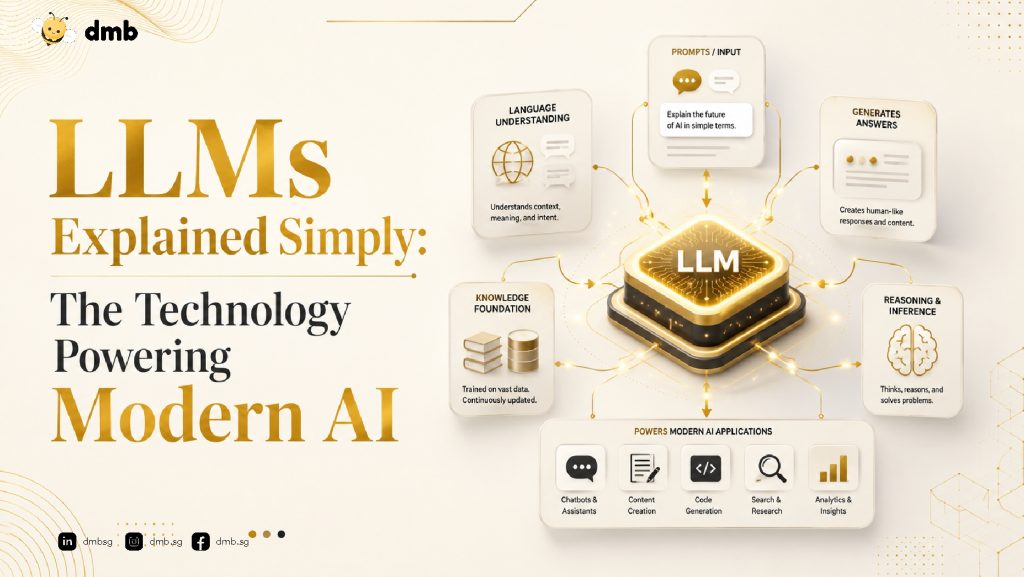
Artificial intelligence has moved from a specialist technology into a daily business tool. Teams now use AI to draft marketing copy, summarise reports, support customer service, analyse feedback, generate code, and help employees find information faster.
At the centre of many of these experiences is the large language model, commonly shortened to LLM.
However, understanding LLMs matters for more than technical curiosity. Business owners, marketers, and digital teams need to know what these systems can do, where they can create value, and where human judgment must remain in control.
This guide explains the answer to a common question: what are LLMs? It also explores how they work, why they are relevant to modern businesses, and how to use them responsibly.
What Is LLMs? Understanding Large Language Models
The grammatically correct question is usually “What are LLMs?” LLM stands for Large Language Model.
An LLM is an artificial intelligence model trained on massive amounts of language data. It can recognise patterns in text and generate responses that appear natural, relevant, and context-aware. Depending on the model and its configuration, an LLM can write, translate, summarise, classify information, answer questions, analyse documents, and assist with conversations.
Google describes LLMs as statistical language models trained on massive datasets that can generate and translate text, as well as perform a range of natural language processing tasks. simple terms, an LLM learns how language tends to work.
It does not “think” like a human being. Instead, it identifies patterns between words, phrases, concepts, and contexts. When a user gives it a prompt, the model estimates the most likely and useful continuation based on what it learned during training and the information included in the prompt.
For example, when asked to create a marketing email, an LLM can recognise that the response may need:
- A clear subject line
- A persuasive opening
- Product or service benefits
- A call to action
- A tone suitable for the intended audience
This ability makes LLMs useful across many functions. Nevertheless, useful output still depends on clear instructions, reliable data, human review, and the right business context.
How Transformer Architecture Made Modern AI Possible
Most modern LLMs are built using a deep-learning approach known as the Transformer architecture.
The Transformer was introduced in the influential 2017 research paper Attention Is All You Need. Its key innovation was an attention-based architecture that could process relationships between words more efficiently than earlier sequence models. Why Attention Matters in Language Understanding
Human language is full of context.
Consider this sentence:
“The agency launched the campaign after reviewing the client’s latest audience data.”
To understand the sentence properly, an AI system needs to recognise relationships between “agency,” “campaign,” “client,” and “audience data.” It also needs to understand that the campaign happened after the review.
Attention mechanisms help models assess which words and concepts matter most in relation to one another. Consequently, LLMs can handle more complex prompts than earlier rule-based chatbots or keyword-driven systems.
From Training Data to Useful Responses
An LLM typically goes through several stages before it is ready for real-world use:
- Pre-training
The model learns broad language patterns from very large datasets. - Fine-tuning or post-training
Developers adapt the model for specific tasks, instructions, safety requirements, or industry use cases. - Prompting and context input
Users provide instructions, examples, documents, or data to guide the output. - Evaluation and monitoring
Teams test whether the output is accurate, relevant, safe, and useful in actual workflows.
This is why an LLM can appear flexible. The same underlying model may help one team create campaign ideas while helping another team summarise customer conversations or classify incoming support requests.
Why Large Language Models Matter for Business Growth
LLMs are becoming important because language sits at the heart of most business operations.
Sales teams communicate with prospects. Marketing teams produce content. Customer service teams answer questions. Managers review reports. Product teams collect feedback. HR teams prepare internal documentation.
Therefore, tools that can process and generate language quickly can affect productivity across the organisation.
Stanford’s 2026 AI Index reported that organisational AI adoption reached 88% in 2025, while 70% of organisations used generative AI in at least one business function. ever, adoption alone is not the goal. The real question is whether an LLM improves a workflow that matters.
Where LLMs Can Create Practical Value
For business and marketing teams, common LLM opportunities include:
- Drafting first versions of blogs, emails, landing pages, and ad copy
- Summarising long documents, meeting notes, or research reports
- Analysing customer reviews and identifying recurring pain points
- Building internal knowledge assistants for company policies or product information
- Supporting multilingual communication and content localisation
- Classifying inbound leads or customer enquiries
- Producing content outlines based on search intent and audience needs
- Helping developers explain, review, or generate code
For structured and measurable work, the potential impact can be meaningful. Stanford’s 2026 AI Index summarised studies reporting productivity gains of roughly 14% to 15% in customer support, 26% in software development, and 50% in marketing output. At the same time, it cautioned that gains are smaller for work requiring deeper reasoning and that over-reliance can weaken learning over time. t distinction is important.
LLMs are often best used to accelerate preparation, repetition, synthesis, and first-draft work. They should not automatically replace expert review, strategic thinking, customer empathy, or accountability.
Common LLM Use Cases Across Marketing and Customer Experience
The practical value of LLMs becomes clearer when viewed through business workflows rather than technology labels.
Content Research and SEO Planning
Marketing teams can use LLMs to organise topic clusters, identify possible customer questions, create content outlines, and generate first-draft content briefs.
However, an LLM should not become the only source of research. A strong article still needs:
- First-hand insights
- Current data and reputable citations
- Expert perspectives
- Original examples
- Clear editorial review
- A point of view that reflects the brand’s expertise
This is especially important for search visibility. Generic content can be created quickly, but useful content requires real depth.
Customer Support Assistance
LLMs can help customer service teams summarise conversations, draft suggested replies, route tickets, and retrieve relevant knowledge-base answers.
Still, businesses should use safeguards for sensitive customer interactions. For example, high-risk complaints, refund disputes, legal concerns, financial matters, or medical questions should have clear escalation paths to qualified human staff.
Sales Enablement and Lead Qualification
Sales teams can use LLMs to summarise calls, create follow-up drafts, identify frequently asked questions, and organise lead information.
Yet, an LLM cannot fully judge whether a prospect is genuinely ready to buy. Sales qualification still requires context, relationship-building, commercial judgment, and an understanding of customer intent.
Voice-of-Customer Analysis
When businesses receive hundreds or thousands of reviews, survey answers, chat logs, or social-media comments, LLMs can help identify repeated themes.
For instance, a brand may discover that customers frequently mention slow response times, unclear pricing, complicated onboarding, or a strong preference for a particular product feature.
Used well, this can help marketing, product, and customer experience teams make better decisions faster.
LLMs, Generative AI, Chatbots, and AI Agents: What Is the Difference?
These terms are often used interchangeably, but they are not the same.
| Term | What It Means | Example |
| Large Language Model | The underlying AI model that understands and generates language | A model that can answer questions or summarise text |
| Generative AI | A broader category of AI that creates new content | Text, images, audio, video, or code generation |
| AI Chatbot | A user-facing conversational interface | A website assistant that answers customer questions |
| AI Agent | A system that can plan tasks, use tools, and take actions toward a goal | An assistant that checks a database, drafts an email, and updates a CRM |
An LLM can power a chatbot, but an LLM is not automatically a chatbot. Likewise, an AI agent may use an LLM as its reasoning or language layer, while also connecting to external tools, data sources, and workflows.
This distinction helps businesses choose the right solution. Sometimes a simple knowledge-base chatbot is enough. In other cases, a more advanced system with secure data access, approval flows, and automation may be necessary.
The Limits of Large Language Models
LLMs can be impressive, but they are not guaranteed to be correct.
One major issue is known as hallucination. This happens when a model generates information that sounds confident and plausible but is inaccurate, fabricated, or unsupported by facts.
Research on LLM hallucination distinguishes between factuality problems, where an answer conflicts with verifiable real-world information, and faithfulness problems, where an answer does not properly follow the user’s context or instruction. s creates several risks for businesses:
- Incorrect product information
- Inaccurate legal or financial statements
- Invented sources or citations
- Misleading customer responses
- Exposure of confidential information
- Biased or inappropriate language
- Poor decisions based on unverified output
NIST’s Generative AI Profile was created to help organisations identify risks unique to generative AI and align risk-management actions with their business goals and priorities. refore, the right mindset is not “LLMs are unreliable, so avoid them.” It is “LLMs need a governance model that matches the level of risk.”
RAG vs Fine-Tuning: Two Ways to Make LLMs More Useful
A general-purpose LLM may not know your latest product information, policies, pricing, or internal documentation. Businesses usually address this through retrieval-augmented generation, known as RAG, or through fine-tuning.
Retrieval-Augmented Generation for Current Knowledge
RAG gives an LLM access to approved external knowledge, such as internal documents, product catalogues, help-centre articles, or policy pages.
Before generating an answer, the system retrieves relevant information and includes it in the prompt context. This can help the model provide more grounded answers based on current company information.
RAG is often useful when information changes regularly, such as:
- Product features
- Pricing details
- Inventory information
- Internal policies
- Campaign guidelines
- Customer-support documentation
Fine-Tuning for Specialised Behaviour
Fine-tuning involves further training a pre-trained model on a task-specific dataset. It can help adapt the model to particular language, classification tasks, brand tone, or recurring workflows. gle’s guidance notes that RAG augments prompts with external knowledge, whereas fine-tuning changes model parameters for a specialised task. Both approaches have trade-offs, including cost, data requirements, maintenance needs, and remaining hallucination risk. many businesses, the most sensible starting point is not training a custom model. It is usually a controlled RAG implementation, strong prompting, access permissions, and human review.
A Responsible LLM Adoption Framework for Businesses
Businesses should begin with a clear use case rather than an AI tool.
A practical adoption process can look like this:
1. Start With a Measurable Problem
Choose a repetitive, time-consuming, language-heavy workflow.
Examples include summarising customer feedback, drafting sales follow-ups, improving internal knowledge search, or categorising support tickets.
2. Define Human Responsibility
Decide which outputs can be automated, which require approval, and which should never be delegated to AI.
For example, a marketing draft may be edited by a content strategist, while a legal response must always be reviewed by qualified professionals.
3. Protect Sensitive Data
Create clear rules about what employees can and cannot enter into AI systems.
Customer data, financial documents, confidential strategy files, passwords, and private employee information should be handled according to internal security and privacy requirements.
4. Test Before Scaling
Evaluate the system using real examples. Measure output quality, accuracy, response time, employee adoption, customer impact, and error rates.
5. Monitor and Improve Continuously
LLM performance can change depending on prompts, source data, model updates, and user behaviour. Review outputs regularly and improve the process over time.
Conclusion: LLMs Are Powerful, but Context Creates Value
Large language models are changing how businesses create content, manage information, support customers, and improve internal productivity.
However, LLMs should not be treated as magic tools that automatically create business growth. Their real value comes from combining AI capability with reliable data, clear workflows, human expertise, and responsible governance.
The strongest LLM strategy is not to automate everything. Instead, it is to identify the moments where language work is repetitive, measurable, and time-consuming—then use AI to make people faster, better informed, and more focused on high-value decisions.
For marketers, business owners, and technology teams, that is the real opportunity behind LLMs.
Free Expert
Digital Marketing Consultation
Our expert digital marketing consultants offer you a no-risk marketing consultation that covers
Developing a tailored strategy to boost your leads and sales.
Uncovering the five key elements vital for digital marketing success.
See what your competitors are up to and learn how to beat them.