


Content marketing has traditionally focused on attracting visitors through search rankings, social media, email, and referral traffic. A business identified relevant keywords, published useful articles, earned visibility, and guided readers toward a service, product, or next action.
That model still matters. However, the path between a question and a website visit is changing.
AI-powered search tools can now summarise information, compare options, suggest follow-up questions, and cite multiple sources before a user clicks through to a website. As a result, content marketers are no longer competing only for a position on a results page. They are also competing to be useful enough, credible enough, and distinctive enough to become part of an AI-generated answer.
This does not mean that SEO is disappearing. In fact, Google states that its generative search features remain grounded in its core Search ranking and quality systems. Pages still need to be crawlable, indexed, technically sound, and genuinely helpful to users.
The difference is that content marketing now needs to support a broader form of discovery: keyword search, question-based search, conversational prompts, AI summaries, and deeper research journeys.
How AI-Powered Discovery Changes Content Strategy
AI search changes the way people express intent.
Instead of searching only for “content marketing agency” or “SEO strategy,” users may ask more specific questions such as:
“How can a B2B company improve organic traffic without publishing low-quality blog posts every week?”
That single question includes several needs at once:
- Organic traffic growth
- Content quality
- B2B marketing
- Publishing frequency
- SEO risk
- Long-term strategy
Google explains that generative search can use “query fan-out,” where the system runs multiple related searches to gather information across subtopics before forming an answer.
Therefore, a content strategy built around one keyword alone is often too narrow. Marketers need to understand the wider question ecosystem surrounding a topic.
This shift also affects traffic expectations. A Pew Research Center analysis of 68,879 Google searches found that AI summaries appeared in 18% of searches studied. When users saw an AI summary, they clicked a traditional result in 8% of visits, compared with 15% when no AI summary appeared. Only 1% clicked a source link inside the AI summary itself.
The implication is not that content no longer matters. Rather, content needs to earn attention at a higher standard. A page that merely repeats a basic definition may satisfy the AI summary without giving readers a reason to visit. A page that provides original research, practical examples, strong analysis, or an expert point of view is more likely to remain valuable.
AI Search for Content Marketing: A Better Operating Model
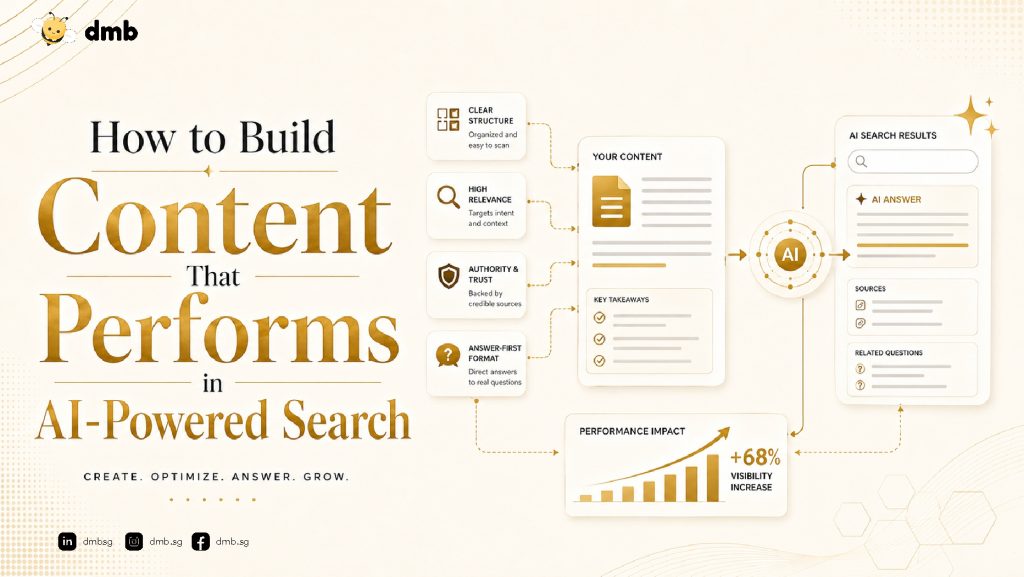
AI Search for Content Marketing is not about writing specifically for robots or chasing a new set of “AI ranking hacks.” It is about creating content that answers real questions clearly while offering value beyond what a generic summary can provide.
A strong operating model combines four priorities:
| Priority | What It Means for Content Marketing |
| Discoverability | Pages should be crawlable, indexed, internally linked, and easy for search systems to understand. |
| Answerability | Content should address the user’s question early, clearly, and with useful context. |
| Differentiation | Articles should include expertise, first-hand insight, original analysis, or practical frameworks. |
| Trust | Claims should be accurate, sourced, current, and supported by transparent author or brand credibility. |
This approach makes content more resilient across traditional SEO and emerging AI discovery experiences.
For example, a generic article titled “What Is Customer Retention?” may explain the definition correctly. Yet a stronger article would also explain how retention affects profitability, which metrics matter, where businesses lose customers, and what actions to prioritise first.
The second article is more useful to a reader—and more likely to stand out in an answer-driven search environment.
Move From Individual Keywords to Question Ecosystems
Keyword research remains essential. However, content marketers should now move beyond isolated phrases and map the questions, concerns, constraints, and decisions around a topic.
Consider the core topic: content marketing strategy.
A traditional keyword list may include:
- Content marketing strategy
- Content marketing plan
- Content marketing examples
- Content marketing agency
- Content marketing ROI
A question ecosystem adds more depth:
- How do I create a content marketing strategy with a limited budget?
- Why does my blog get traffic but not generate leads?
- What content formats work best for B2B lead generation?
- How can I measure whether content influences sales?
- Should I update old articles or create new ones?
- How does AI search affect content traffic?
This broader map helps marketers create content clusters rather than disconnected blog posts.
Build Content Around the Customer Journey
A useful framework is to organise topics by the user’s stage of awareness.
| Customer Stage | Typical Question | Recommended Content Format |
| Awareness | “What is content marketing?” | Educational guide |
| Problem discovery | “Why is my blog not driving leads?” | Diagnostic article |
| Consideration | “SEO content vs paid advertising: which is better?” | Comparison article |
| Evaluation | “How do I choose a content marketing agency?” | Buyer’s guide |
| Implementation | “How do I build a content calendar?” | Step-by-step framework |
| Optimisation | “How do I improve underperforming content?” | Audit checklist or playbook |
This structure helps a website cover a topic more comprehensively while offering logical internal-link paths between articles.
Create Non-Commodity Content That Earns Attention
The content most likely to lose value in AI search is generic content: articles that repeat obvious advice, paraphrase competitor pages, or offer broad lists without a clear perspective.
Google’s guidance for generative AI search emphasises unique, useful, non-commodity content. It specifically encourages first-hand perspectives, expert-led information, clear organisation, and material that goes beyond common knowledge.
For content marketers, this is where E-E-A-T becomes practical.
Show Experience
Experience comes from doing the work.
A content team can demonstrate experience by including lessons from campaign execution, client challenges, process changes, experiments, anonymised outcomes, or common mistakes observed in real projects.
For example, instead of writing:
“Use internal links to improve SEO.”
A more experience-led insight might be:
“When a high-traffic educational article has no internal path to a relevant service page, it can attract attention without supporting commercial outcomes. Adding contextual links to related comparison guides, case studies, and conversion pages can help bridge that gap.”
The second example gives readers a clearer reason to trust the advice.
Demonstrate Expertise
Expertise is visible when the content explains complex ideas accurately and in context.
This may include:
- A clear methodology
- Industry-specific examples
- Defined metrics
- Decision criteria
- Limitations and trade-offs
- Current research or official guidance
Google’s people-first content guidance encourages creators to provide original information, substantial coverage, insightful analysis, and value beyond simply rewriting existing sources.
Strengthen Authority and Trust
Authority grows over time through consistent coverage, credible authors, useful resources, reliable sources, and genuine recognition in the market.
Trust, meanwhile, requires discipline. Marketers should avoid inflated claims, fabricated statistics, vague case studies, or unsupported promises. Every important assertion should be reviewed, sourced where appropriate, and updated when conditions change.
Write for Direct Answers Without Sounding Robotic
One common mistake is assuming that AI search requires short, mechanical writing.
It does not.
Clear structure helps answer engines understand content, but people still need an article that feels coherent, readable, and useful. The best approach is to layer information.
Start by answering the main question directly. Then expand with context, examples, supporting evidence, and practical next steps.
A reliable article structure often looks like this:
- Direct answer
Explain the topic in one or two clear paragraphs. - Why it matters
Connect the topic to a business, marketing, or customer problem. - How it works
Break down processes, frameworks, or relevant factors. - Examples and evidence
Add research, first-hand insights, case examples, or comparisons. - Practical implementation
Give readers a realistic starting point. - Limitations or common mistakes
Show where assumptions can fail. - Next step
Link to a related guide, template, service page, or consultation pathway.
This structure serves both search systems and human readers. It also supports longer, more conversational questions that may lead users to AI-powered search experiences.
Use AI as a Research Partner, Not a Content Factory
AI can accelerate content workflows. It can help marketers organise research notes, group keywords by intent, identify likely questions, create outline options, summarise interview transcripts, and prepare early drafts.
However, it should not become a replacement for editorial judgment.
Google states that generative AI can be useful for research and for adding structure to original content. At the same time, publishing many AI-generated pages without adding value may violate Google’s scaled content abuse policy.
A responsible workflow looks like this:
- Use AI to expand initial topic ideas.
- Validate claims using primary sources, expert interviews, and current data.
- Add first-hand business insight.
- Review facts, examples, and citations manually.
- Edit for voice, clarity, and audience relevance.
- Publish only when the article offers a real reason to exist.
AI can speed up preparation. It cannot replace the strategic thinking required to decide what the audience truly needs.
Technical Foundations Still Matter for Content Discovery
Even the best article cannot perform well if search systems cannot access it.
Google recommends maintaining a clear technical structure, ensuring content is crawlable, reducing duplicate content, improving page experience, and making pages eligible for indexing and snippets.
For content marketing teams, this means regularly reviewing:
- Indexation status
- XML sitemaps
- Internal links
- Canonical tags
- Broken pages and redirects
- Mobile usability
- Core Web Vitals
- Structured data accuracy
- Page speed
- Content hidden behind inaccessible scripts or interactions
For visibility in ChatGPT search, OpenAI states that websites opted out of OAI-SearchBot will not be shown in ChatGPT search answers, although they may still appear as navigational links.
This should be evaluated alongside each organisation’s content, privacy, and crawler-access policies. It is not a content strategy by itself, but it is an important technical decision for brands that want to remain discoverable across AI search platforms.
Measure Content Value Beyond Raw Clicks
Traffic remains useful, but it is no longer enough to assess content performance through sessions alone.
A stronger measurement framework should include:
- Organic impressions
- Organic clicks
- Click-through rate
- Rankings by topic cluster
- Engagement time and scroll depth
- Assisted conversions
- Form submissions influenced by content
- Newsletter subscriptions
- Branded search growth
- Referral traffic from AI platforms
- Visibility for high-intent informational queries
Google Search Console provides performance data by query, page, country, impressions, and clicks, making it a practical starting point for identifying which topics are gaining or losing visibility.
The key is to connect content metrics with business outcomes. An article that attracts fewer visits but influences qualified leads, product consideration, or sales conversations may be more valuable than a high-traffic article with no meaningful next step.
A Practical 90-Day Content Marketing Plan for AI Search
Days 1–30: Audit What Already Exists
Identify pages that already attract impressions, traffic, backlinks, or conversions. Review whether they provide clear answers, current examples, relevant internal links, strong author signals, and enough depth to remain useful.
Days 31–60: Upgrade Priority Content
Focus on articles that already have potential. Add direct answers near the beginning, improve semantic headings, include real examples, refresh data, strengthen internal links, and remove vague or repetitive sections.
Days 61–90: Build Topic Authority
Publish supporting content around the most valuable themes. Create comparison guides, diagnostic articles, implementation playbooks, FAQs, and case-driven resources that help users move from awareness to action.
The goal is not to publish more pages. It is to build a stronger information ecosystem around the questions your audience genuinely cares about.
Common Mistakes to Avoid
Treating AI Search as a Separate Channel From SEO
AI search visibility still depends on accessible, indexed, useful web content. SEO fundamentals remain essential.
Creating an Article for Every Prompt Variation
Google warns against producing pages mainly to target every possible query variation or fan-out query. Focus on comprehensive topic coverage instead of multiplying thin pages.
Chasing Unsupported Technical Shortcuts
Google states that special files such as llms.txt, forced content “chunking,” or specific AI-only writing styles are not required for visibility in its generative search features.
Prioritising Volume Over Originality
Publishing faster is not the same as becoming more useful. Original research, expert commentary, practical frameworks, and first-hand insights are far harder to replace with a generic AI summary.
Conclusion
AI search is changing how people discover, evaluate, and trust content. For content marketers, the response should not be panic, keyword stuffing, or mass-producing AI-generated articles.
Instead, the priority should be clearer: create content that answers real questions, provides evidence, demonstrates experience, and helps readers make better decisions.
The future of content marketing will not belong to the brands that publish the most. It will belong to the brands that consistently create the most useful, distinctive, and trustworthy resources for their audience.
Free Expert
Digital Marketing Consultation
Our expert digital marketing consultants offer you a no-risk marketing consultation that covers
Developing a tailored strategy to boost your leads and sales.
Uncovering the five key elements vital for digital marketing success.
See what your competitors are up to and learn how to beat them.