


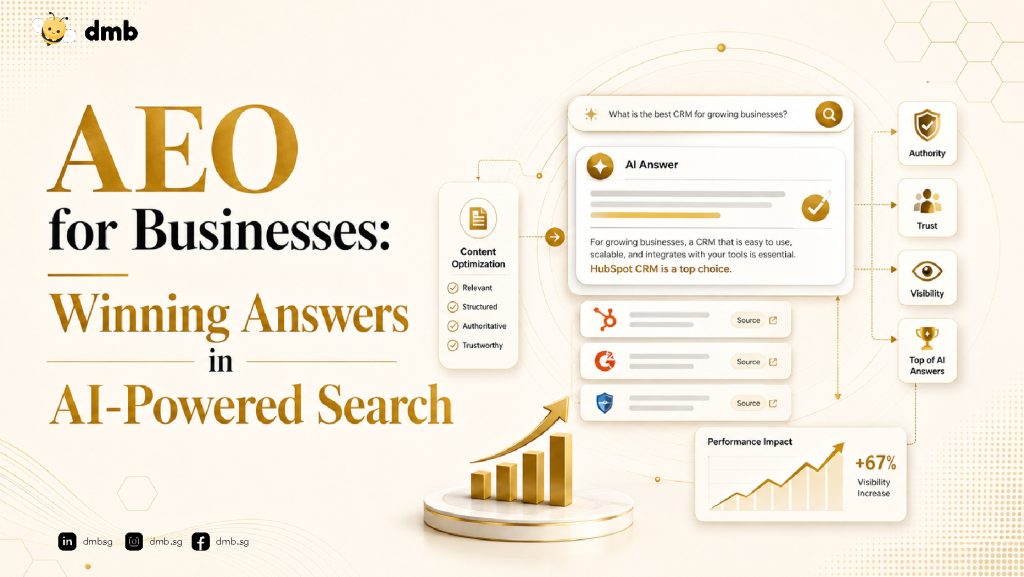
Search is changing from a list of links into a more direct, conversational experience.
Instead of typing a short keyword and comparing several websites, users can now ask detailed questions, describe their needs, add constraints, and receive an AI-generated response with supporting sources. A person researching marketing software, for example, may ask which platform suits a small team with a limited budget, CRM integration needs, and reporting requirements.
This shift changes the role of content.
Businesses still need strong SEO fundamentals. However, they also need content that can be understood, trusted, and surfaced when answer engines generate a response. This is where an AEO Strategy becomes relevant.
AEO, or Answer Engine Optimization, is the practice of improving content and digital assets so they can better support direct answers in AI-powered search, voice assistants, generative search experiences, and other conversational discovery tools.
It is not a replacement for SEO. Instead, AEO extends SEO by focusing on the questions behind a search query, the evidence users need, and the clarity that answer engines need to identify useful information.
For marketers, business owners, and technology teams, the goal is simple: create content that does not merely rank, but genuinely helps people reach an answer.
What Answer Engine Optimization Means for Modern Search
Answer Engine Optimization is often discussed as a new discipline. However, its core principles are familiar: understand user intent, provide accurate information, structure content clearly, and demonstrate trust.
The difference is that answer engines can interpret more complex questions than traditional search interfaces. They can also combine information from multiple sources before generating a response.
Google explains that AI Overviews and AI Mode may use a “query fan-out” process, meaning the system can conduct multiple related searches across subtopics and data sources to develop a more complete answer.
For example, a user may ask:
“How can a growing e-commerce brand improve customer retention without relying heavily on discounts?”
An answer engine may explore several connected topics at once:
- Customer loyalty strategies
- Email and WhatsApp retention campaigns
- Membership programmes
- Personalisation
- Customer service quality
- Repeat-purchase incentives
- Customer lifetime value
- Industry examples
Therefore, one prompt can lead to several hidden searches. AEO helps brands prepare content that addresses these connected needs rather than optimising only for one exact phrase.
Why Answer-First Discovery Changes Content Strategy
Traditional SEO often begins with a keyword list. An AEO Strategy begins with a question ecosystem.
That ecosystem includes the user’s problem, context, intent, risk, preferred outcome, and decision criteria.
For instance, “best SEO agency” is a broad commercial query. However, a more detailed AI-search prompt may be:
“How do I choose an SEO agency that can improve qualified traffic without relying on low-quality backlinks?”
The second question reveals far more. The user is not only looking for an agency. They are looking for credibility, sustainable methods, risk reduction, and evidence of quality.
This means high-performing content needs to answer more than basic definitions. It should explain trade-offs, provide decision criteria, show practical examples, and help readers assess what matters.
A 2025 Pew Research Center analysis of 68,879 Google searches from 900 consenting US adults found that AI summaries appeared in 18% of searches. Users clicked a traditional search result in 8% of visits with an AI summary, compared with 15% when no summary appeared. Longer, question-based searches were also more likely to trigger AI summaries.
This does not mean organic traffic will disappear. However, it does mean that businesses should not rely only on keyword rankings and click volume. They should also focus on being useful enough to be referenced, cited, explored, or remembered during answer-led discovery.
AEO vs SEO: Where the Two Strategies Overlap
AEO and SEO should work together.
SEO helps search engines crawl, index, understand, and rank a page. AEO makes the same page more useful for direct-answer environments by improving clarity, structure, evidence, and topical depth.
| SEO Focus | AEO Focus |
| Ranking for relevant search queries | Supporting direct answers and conversational discovery |
| Keywords, technical SEO, and backlinks | Questions, context, evidence, and answer clarity |
| Search-result visibility | Visibility in AI search, voice, snippets, and answer experiences |
| Page-level optimisation | Topic-level authority and information completeness |
| Click-through rate and organic traffic | Visibility, qualified traffic, trust, and assisted conversions |
Importantly, Google does not require a separate technical implementation to appear in AI Overviews or AI Mode. A page must be indexed and eligible to appear in Google Search with a snippet, while established SEO best practices remain relevant.
In other words, there is no shortcut called “AI ranking code.”
A strong AEO Strategy begins with the fundamentals:
- Crawlable and indexable pages
- Clear internal linking
- Useful text-based content
- Good page experience
- Accurate information
- Strong topical relevance
- Accessible design
- Relevant structured data
- Credible authorship and sourcing
Build an AEO Strategy Around Real Customer Questions
The strongest answer-focused content is built around real customer language.
Instead of asking only, “Which keyword has the highest search volume?”, ask:
- What problem is the audience trying to solve?
- What confusion or risk is delaying their decision?
- What comparison are they trying to make?
- What proof do they need before they trust an answer?
- What follow-up questions are likely to come next?
This creates a more useful content framework.
1. Map the Core Topic
Start with a broad subject that connects to your business, such as:
- Search engine optimisation
- Customer retention
- Marketing automation
- Paid advertising
- Website conversion
- CRM implementation
- Brand positioning
- AI adoption
Then identify the main questions users ask at different stages of awareness.
2. Identify Question Variations
For a topic such as “website conversion rate,” relevant question variations may include:
- Why is my website getting traffic but not leads?
- What are the most common landing-page mistakes?
- How can I improve form completion rates?
- What should be included on a high-converting service page?
- How do I measure website conversion performance?
These questions can become section headings, FAQ content, supporting articles, lead magnets, or sales-enablement resources.
3. Add Context and Constraints
Users rarely make decisions in a vacuum.
A small business, enterprise company, B2B service provider, e-commerce brand, and local retailer may all ask similar questions. Yet, their budgets, resources, customer journeys, and priorities can be very different.
Therefore, create content that includes context such as:
- Industry
- Business size
- Customer type
- Budget level
- Team capability
- Technology stack
- Sales cycle length
- Regulatory or operational constraints
This makes the content more useful for both users and answer engines.
Create Content That Gives a Clear, Complete Answer
Answer engines favour content that can be interpreted easily. However, clarity does not mean reducing every topic into a shallow paragraph.
A strong answer-led page usually follows a layered structure:
- Give a direct answer early
Start with a concise explanation of the topic. - Expand with context
Explain why the issue matters and when it applies. - Use scannable sections
Break complex topics into clear H2 and H3 headings. - Provide supporting evidence
Use reputable data, relevant examples, expert commentary, and transparent references. - Address common follow-up questions
Anticipate comparisons, objections, implementation issues, and limitations. - Guide the next action
Link to relevant resources, tools, templates, service pages, or deeper articles.
For example, an article about customer retention should not only define retention. It should explain why retention affects profitability, how teams can measure it, which channels support it, and where common programmes fail.
This is what turns a simple informational article into a resource worth citing.
Strengthen E-E-A-T With Evidence and Experience
AEO is not only about making content easy for machines to interpret. It is also about making content trustworthy for people.
Google’s people-first content guidance encourages creators to demonstrate first-hand expertise, substantial value, clear authorship, accuracy, and a satisfying reader experience. Google also notes that trust is the most important part of its E-E-A-T framework.
For businesses, E-E-A-T can be strengthened through practical content elements:
Show Experience
Include insights gained from genuine work, such as campaign lessons, implementation challenges, before-and-after outcomes, customer patterns, or anonymised examples.
Demonstrate Expertise
Explain difficult concepts clearly. Use accurate terminology, practical frameworks, and sources that support important claims.
Build Authoritativeness
Publish content consistently within relevant topic clusters. Strengthen author profiles, service pages, case studies, expert bios, and digital brand signals.
Protect Trust
Use reliable references, disclose assumptions, update outdated information, and avoid exaggerated claims.
A generic article can explain what a marketing funnel is. A stronger article explains how funnel performance changes when lead qualification is weak, what data should be reviewed, and which improvements should be prioritised first.
That difference is where expertise becomes visible.
Use Structured Data to Clarify, Not Manipulate
Structured data can help search engines understand the meaning of content on a page.
Google explains that structured data provides explicit clues about a page’s content and can make a page eligible for richer Search appearances. However, the markup must accurately describe visible content and should not be used to create empty pages or misleading signals.
For an AEO Strategy, relevant structured data may include:
- Article
- Organization
- Person
- BreadcrumbList
- Product
- Service
- LocalBusiness
- FAQPage, where appropriate and supported
- Review or aggregate rating markup, only when valid
Structured data is not a guarantee of AI visibility. It is also not a substitute for useful content.
Instead, think of it as context reinforcement. It helps systems understand who created the content, what the page is about, and how the information relates to the wider web.
Improve Technical Foundations for Answer Visibility
Even excellent content cannot be surfaced consistently if technical issues prevent discovery.
A practical AEO Strategy should include regular checks for:
- Robots.txt and indexing restrictions
- XML sitemap coverage
- Canonical tags
- Broken internal links
- Mobile usability
- Page loading speed
- JavaScript rendering issues
- Duplicate or thin pages
- Missing metadata
- Weak internal-link pathways
- Important information hidden in images or interactive elements
Google specifically recommends making content easy to find through internal links, allowing crawling, providing a strong page experience, and ensuring important content is available in text form.
Therefore, technical SEO remains one of the most important AEO foundations.
Measure AEO Performance Beyond Rankings
AEO does not yet have one universal reporting metric. However, businesses can create a more complete measurement framework.
Track conventional SEO indicators such as:
- Organic impressions
- Organic clicks
- Ranking trends
- Click-through rate
- Organic conversions
- Assisted conversions
- Engagement by content cluster
Then add answer-engine indicators, including:
- Brand mentions in AI search responses
- Supporting-link appearances in AI features
- Referral traffic from AI platforms
- Visibility of priority pages in AI search results
- Growth in branded searches
- Engagement with answer-focused content
- Conversion contribution from informational pages
In June 2026, Google began rolling out dedicated Search Generative AI performance reports in Search Console to a subset of websites. These reports provide views of impressions, pages, countries, devices, and time-based visibility within AI features such as AI Overviews and AI Mode.
This is a useful signal that generative-search visibility is becoming more measurable. Still, marketers should avoid judging success through one dashboard alone. The goal is not simply to “appear in AI.” The goal is to build trust and support meaningful business outcomes.
Common AEO Mistakes to Avoid
Treating AEO as a Replacement for SEO
AEO without solid technical SEO is fragile. Your pages still need to be accessible, indexable, useful, and well structured.
Writing Only for Machines
Overly rigid content may be easy to parse but difficult to read. Write for people first, then organise the content so systems can understand it.
Publishing Generic AI Content at Scale
Google warns against using automation to produce large volumes of content without adding value for users. Content should offer original insight, clear purpose, and meaningful depth.
Ignoring Content Quality After Publication
Answer-oriented content needs maintenance. Refresh statistics, improve examples, review internal links, and update recommendations when markets or technologies change.
Chasing Unsupported “AEO Hacks”
There is no single plugin, file, or markup trick that guarantees AI citations. Sustainable visibility comes from strong content, trustworthy signals, technical health, and audience relevance.
Conclusion
An AEO Strategy is not about abandoning SEO for the latest AI trend.
It is about adapting to a search environment where people ask more complete questions and expect clearer, more direct answers. Businesses that respond with shallow content, keyword repetition, or generic automation may struggle to build trust.
By contrast, businesses that create useful, evidence-based, well-structured content can improve their ability to appear across traditional search, AI-powered search, voice experiences, and future answer platforms.
The most effective strategy is simple: understand the question behind the query, give a genuinely useful answer, support it with credible evidence, and make it easy for both people and search systems to understand.
Free Expert
Digital Marketing Consultation
Our expert digital marketing consultants offer you a no-risk marketing consultation that covers
Developing a tailored strategy to boost your leads and sales.
Uncovering the five key elements vital for digital marketing success.
See what your competitors are up to and learn how to beat them.