


Large language models have become part of everyday work. Marketing teams use them to shape campaign ideas, draft content, and analyse customer feedback. Sales teams use them to summarise calls and prepare follow-ups. Meanwhile, customer support and technology teams use them to organise knowledge, assist conversations, and accelerate repetitive tasks.
Yet, behind every AI-generated paragraph, chatbot reply, or summary is a deeper technical system.
Large language models, or LLMs, are not simply “smart writing tools.” They are built on a combination of language data, mathematical representations, neural-network architecture, large-scale training, instruction-following methods, and—when implemented well—human oversight.
Understanding the Foundation of LLMs helps businesses make better decisions about where AI can create value. More importantly, it helps teams recognise where the technology needs reliable data, structured workflows, and expert review.
This matters because generative AI is no longer limited to experiments. Stanford’s 2026 AI Index found that 79% of surveyed organisations reported regularly using generative AI in at least one business function.
However, adoption alone does not create impact. The real advantage comes from understanding the technology well enough to use it with purpose.
Foundation of LLMs: The Core Building Blocks Behind AI Language
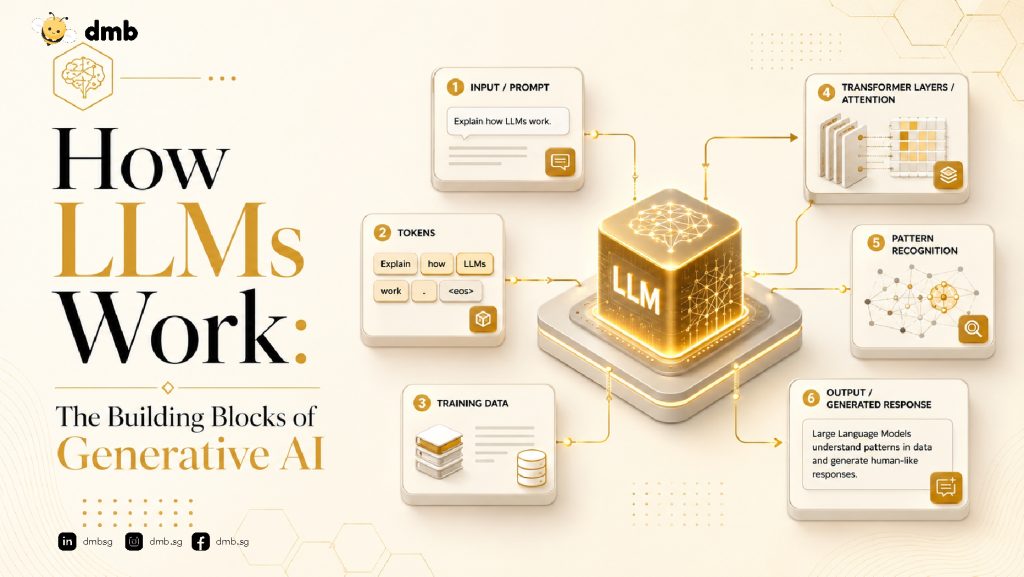
An LLM is a type of artificial intelligence designed to process and generate human-like language. It learns patterns from massive amounts of text, code, documents, and other forms of language data.
Rather than storing every sentence like a traditional database, an LLM identifies relationships between words, concepts, sentence structures, and contexts. When a user enters a prompt, the model predicts the most likely next word or phrase based on patterns it learned during training.
For example, when asked to draft a product description, an LLM may recognise that the output should include:
- A product introduction
- Key benefits and differentiators
- A tone appropriate for the target audience
- Supporting details or specifications
- A clear call to action
However, this does not mean the model understands a product, customer, or business strategy in the same way a human does. It identifies patterns and generates likely language outputs. Therefore, context remains essential.
The main foundations of an LLM include:
| Core Component | Role in an LLM | Business Relevance |
| Tokens | Break text into smaller processable units | Determines how prompts, documents, and language are processed |
| Embeddings | Convert language into mathematical representations | Helps AI recognise meaning, similarity, and context |
| Transformer architecture | Connects relationships across words and ideas | Enables context-aware responses |
| Training data | Teaches language patterns and knowledge | Influences quality, bias, and breadth of output |
| Parameters and computing power | Increase model capacity | Supports more complex tasks and pattern recognition |
| Alignment methods | Improve instruction-following and safety | Makes output more useful for real users |
| Retrieval systems | Connect the model to verified external knowledge | Helps keep business answers current and grounded |
Together, these layers create the experience users recognise as generative AI.
From Words to Tokens: How AI Converts Language Into Information
Before an LLM can process language, it must convert text into smaller units called tokens.
A token can be a full word, part of a word, punctuation, a number, or a symbol. For instance, a familiar word may be processed as one token, while a long or uncommon term might be divided into several smaller pieces.
This approach helps language models work with a broad range of vocabulary, including new words, technical phrases, brand names, programming languages, and multilingual content.
Research into subword tokenisation showed that breaking language into smaller components can help models handle rare and previously unseen words more effectively than systems that rely only on a fixed vocabulary.
Once text is tokenised, the model turns those tokens into numerical representations called embeddings.
An embedding is essentially a mathematical map of meaning. It helps the model recognise that certain concepts are connected.
For example, an LLM may learn that:
- “Campaign,” “advertising,” and “promotion” often appear in related contexts.
- “Revenue,” “conversion,” and “sales” may be connected in business discussions.
- “Customer retention,” “loyalty,” and “repeat purchase” are often conceptually related.
This is one reason why detailed prompts perform better than vague prompts. The more useful context a business gives the model, the more relevant its output can become.
Transformer Architecture: Why Modern LLMs Handle Context Better
The most important technical breakthrough behind modern LLMs is the Transformer architecture.
In 2017, researchers introduced the Transformer model through the paper Attention Is All You Need. Unlike earlier approaches that relied heavily on sequential processing, the Transformer used attention mechanisms to understand relationships between different parts of a sentence more efficiently.
The key principle is known as self-attention.
Self-attention allows the model to examine how words and phrases relate to one another within a larger context.
Consider this sentence:
“The marketing team revised the campaign after reviewing customer feedback.”
To understand the sentence, the model needs to connect:
- “Marketing team” with the action “revised”
- “Campaign” with the object being changed
- “Customer feedback” with the reason behind the revision
- “After” with the sequence of events
Self-attention helps the model determine which words are most relevant when interpreting each part of the sentence.
Consequently, Transformers can handle more complex prompts than traditional keyword-matching systems. They are better at recognising context, sentence relationships, and user intent.
For business teams, this means LLMs can assist with tasks that involve multiple instructions, customer segments, product details, or campaign goals. Nevertheless, the output is only as strong as the prompt, source material, and review process behind it.
Training Large Language Models: Data, Scale, and Pattern Recognition
LLMs are first developed through a process called pre-training.
During pre-training, a model is exposed to vast quantities of language data. It repeatedly learns to predict missing words or the next likely token in a sequence. Over time, it becomes better at recognising grammar, writing styles, common facts, coding patterns, and relationships between concepts.
However, bigger is not always automatically better.
A model’s capability depends on several connected factors:
- The quality and diversity of training data
- The number of model parameters
- The computing resources used during training
- The architecture and training approach
- The evaluation process
- The quality of post-training alignment
In practical terms, a large general-purpose model may be useful for broad research, content ideation, or summarisation. However, a smaller or specialised model connected to a company knowledge base may be more appropriate for sensitive internal workflows.
For example, a customer service team does not necessarily need the largest available model. It needs a system that can provide accurate answers using approved product information, policy documents, and customer-support guidelines.
Therefore, the right LLM strategy should begin with the business problem—not with the most popular model.
From Raw Model to Helpful Assistant: Alignment and Human Feedback
A pre-trained model can generate text, but it may not automatically follow instructions well, provide safe responses, or understand what users expect.
This is why many modern LLMs go through additional training stages called post-training or alignment.
Alignment methods may include:
- Supervised fine-tuning
- Instruction tuning
- Human feedback
- Preference ranking
- Reinforcement learning
- Safety testing and evaluation
These processes help guide the model toward responses that are more useful, relevant, and aligned with user needs.
Research into instruction-following language models found that human feedback can significantly improve how well a model responds to user requests. In some cases, evaluators preferred a smaller, aligned model over a much larger model that had not been refined for instruction-following.
For businesses, this creates an important lesson: intelligence alone is not enough.
An AI system used for customer support, recruitment, financial services, healthcare, or legal communication needs clear rules around how it should behave. It must also have a clear process for escalating complex or high-risk questions to humans.
Retrieval-Augmented Generation: Connecting LLMs to Business Knowledge
One major limitation of standalone LLMs is that their knowledge can become outdated. They may also produce an answer that sounds convincing without being fully accurate.
This is where retrieval-augmented generation, commonly known as RAG, becomes useful.
RAG connects an LLM to external information sources, such as:
- Company policies
- Product catalogues
- Customer-support articles
- Internal documentation
- Campaign reports
- Sales playbooks
- Pricing data
- Brand guidelines
Before responding to a question, the system retrieves relevant information from the approved knowledge source. It then gives that information to the LLM as context for the answer.
The original RAG research found that combining a language model with an external knowledge source could generate responses that were more specific, diverse, and factual than a model relying only on its internal parameters.
For example, instead of asking a general AI chatbot, “What is our refund policy?”, an employee could ask an internal RAG-powered assistant. The system would retrieve the latest approved refund policy before generating a response.
However, RAG is only as reliable as the source documents behind it.
If the company knowledge base is outdated, incomplete, poorly organised, or full of conflicting information, the model may still generate weak answers. Therefore, content governance and documentation quality remain essential.
LLM Limitations: Why Accuracy, Privacy, and Governance Matter
LLMs can produce language that is highly fluent and persuasive. However, fluent language is not always accurate language.
A model may generate incorrect claims, invent citations, misunderstand a request, or provide an answer that lacks important context. This is often referred to as hallucination.
Businesses should also consider risks involving:
- Confidential information
- Data privacy
- Intellectual property
- Bias and harmful language
- Inaccurate customer responses
- Compliance requirements
- Over-reliance on automated recommendations
The National Institute of Standards and Technology, or NIST, provides a Generative AI Profile to help organisations identify and manage AI-specific risks. Its AI Risk Management Framework is structured around four key functions: Govern, Map, Measure, and Manage.
A practical governance framework should include the following:
1. Set Clear Data Boundaries
Employees should know which documents, customer details, financial information, and internal data can be used in an AI workflow.
2. Keep Humans Responsible for High-Impact Decisions
LLMs should not make final decisions involving legal advice, financial recommendations, medical issues, employment outcomes, or sensitive customer disputes without qualified human review.
3. Test Real-World Scenarios
Before launching an AI workflow, test it using realistic customer questions, edge cases, inaccurate prompts, and high-risk scenarios.
4. Monitor Output Quality Over Time
AI performance can change when the model, prompts, data sources, or business policies change. Regular reviews are necessary to maintain quality and trust.
What the Foundation of LLMs Means for Marketing Teams
For marketers, the best use of LLMs is not simply producing more content.
The real opportunity is improving the quality and speed of work that supports customer understanding.
Marketing teams can use LLMs to:
- Summarise customer interviews and survey responses
- Cluster reviews into recurring themes
- Generate initial campaign angles
- Create structured content briefs
- Translate and localise first drafts
- Build FAQ outlines from common questions
- Analyse messaging consistency across brand assets
- Organise competitive research notes
Still, a strong marketing strategy requires more than generated text.
It requires positioning, customer insight, brand judgment, creative direction, and performance analysis. An LLM can accelerate preparation and reduce repetitive work. It cannot independently define a brand’s point of view or determine whether a campaign truly connects with an audience.
That is why the strongest AI-enabled teams use LLMs as collaborators, not replacements.
A Practical Checklist Before Implementing an LLM
Before introducing an LLM into a business workflow, ask these questions:
- What specific problem are we solving?
Choose a measurable workflow, such as reducing support response time or organising customer feedback. - What information does the AI need?
Identify the approved documents, databases, and knowledge sources it should access. - What output quality standard is required?
Define what counts as useful, accurate, safe, and brand-appropriate. - Who reviews the output?
Assign responsibility to a person or team rather than assuming the AI is always correct. - How will success be measured?
Track practical outcomes, such as time saved, reduced errors, response quality, engagement, or conversion support.
Conclusion
The foundation of LLMs is not one single innovation. It is a connected system of tokens, embeddings, Transformers, large-scale training, alignment methods, retrieval systems, and responsible governance.
These technologies allow AI to process language at a scale that can support marketing, customer experience, sales, and internal operations.
However, the most valuable LLM strategy is not to automate everything.
Instead, businesses should identify areas where language work is repetitive, time-consuming, and measurable. Then, they should combine AI capability with credible data, expert oversight, and clear accountability.
That is how LLMs become more than a trend. They become a practical tool for better decisions, stronger workflows, and more meaningful business growth.
Free Expert
Digital Marketing Consultation
Our expert digital marketing consultants offer you a no-risk marketing consultation that covers
Developing a tailored strategy to boost your leads and sales.
Uncovering the five key elements vital for digital marketing success.
See what your competitors are up to and learn how to beat them.