


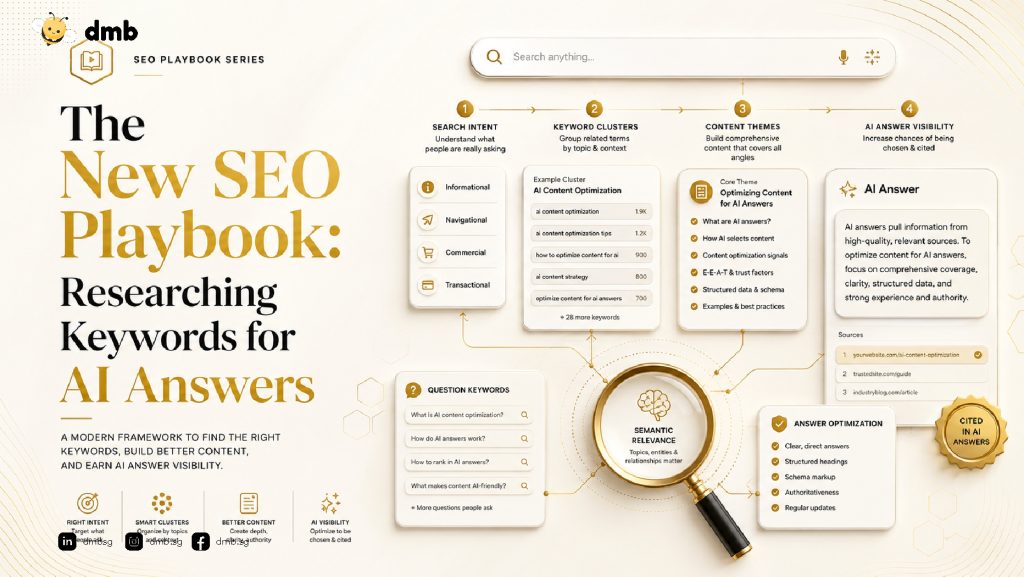
Keyword research has always been one of the foundations of SEO. It helps marketers understand what people search for, how they describe their problems, and which topics are worth creating content around.
However, search behaviour is evolving.
People no longer rely only on short queries such as “best CRM software” or “SEO agency.” Increasingly, they ask complete questions, add business context, compare options, and continue the conversation until they feel ready to act.
For example, instead of searching for:
“email marketing software”
A user may ask:
“What email marketing platform is suitable for a growing B2B business that needs automation, reporting, and CRM integration?”
This change does not make traditional keyword research obsolete. Instead, it expands the role of keyword research.
Today, marketers need to understand both the keyword and the conversation behind it. They need to identify the topic, the user’s goal, the constraints shaping the decision, and the proof that will help the user trust an answer.
That is the core purpose of Keyword Research for LLMs.
It is a research approach designed for a search environment where users interact with AI-powered search engines, AI assistants, and conversational interfaces—not only traditional search result pages.
Keyword Research for LLMs: Why Search Demand Is Becoming More Conversational
Keyword research for LLMs is the process of identifying the topics, questions, prompt patterns, and decision contexts that people use when interacting with AI-driven search experiences.
Traditional keyword research usually focuses on metrics such as:
- Monthly search volume
- Keyword difficulty
- Search intent
- Cost per click
- Ranking opportunity
- Competitor visibility
These metrics still matter. However, they do not always capture the full context of conversational search.
AI-powered search tools can interpret longer, more detailed questions. Google states that AI Overviews and AI Mode may use a “query fan-out” approach, where the system issues multiple related searches across subtopics and data sources to create a response. ult, one detailed prompt may represent several hidden information needs at once.
For example, the prompt below is not only about software:
“Which project management tool is best for a remote marketing team with multiple clients, limited budget, and reporting needs?”
Behind that one question, the user may be researching:
- Project management platforms
- Pricing and budget limits
- Client collaboration
- Remote-work features
- Reporting capability
- Integration options
- Team size suitability
- Reviews and trust signals
Therefore, modern keyword research should not stop at finding one phrase with the highest volume. It should map the broader decision journey around the topic.
From Keywords to Prompt Patterns: Understanding User Context
A keyword tells you what a person may be looking for. A prompt often reveals why they are looking for it.
This is the difference between keyword-led SEO and prompt-led research.
| Traditional Keyword | Conversational Prompt Pattern | Hidden User Need |
| CRM software | “Which CRM is suitable for a small sales team with WhatsApp integration?” | Product comparison and operational fit |
| SEO agency | “How do I choose an SEO agency without wasting budget?” | Trust, risk reduction, and buying confidence |
| marketing automation | “What marketing automation tools work for lead nurturing?” | Process improvement and conversion support |
| AI chatbot | “Can an AI chatbot reduce customer support workload?” | Efficiency, cost, and customer experience |
| website redesign | “When should a business redesign its website for better conversions?” | Business diagnosis and investment justification |
The best research process investigates four layers of intent:
1. Topic Intent
What broad subject is the user exploring?
Examples include AI tools, content marketing, SEO, CRM, e-commerce, customer retention, paid advertising, or website conversion.
2. Outcome Intent
What result does the user want?
They may want more leads, lower acquisition cost, better reporting, stronger customer retention, improved visibility, or faster operations.
3. Constraint Intent
What limitation affects the decision?
Common constraints include budget, team size, technical skills, integration needs, timing, industry regulation, or geographic market.
4. Evidence Intent
What proof does the user need before trusting the answer?
They may need examples, case studies, pricing context, comparison tables, expert opinions, implementation steps, or product reviews.
When research includes all four layers, marketers can create content that feels more useful, more specific, and more relevant to real decision-making.
Why Traditional SEO Still Matters in AI Search
Some marketers assume that AI search means keywords no longer matter. That is not accurate.
Google’s official guidance explains that its generative AI search features remain grounded in core Search ranking and quality systems. Websites still need to meet technical requirements, be indexed, and be eligible to appear in Google Search. words, strong SEO remains the foundation.
This includes:
- Clear website architecture
- Crawlable internal links
- Fast and accessible pages
- Relevant title tags and headings
- Helpful content
- Strong topical coverage
- Accurate structured data where appropriate
- Credible sources and author information
- A positive page experience
Google also recommends that creators use words people would use when looking for their content and place those words in prominent locations such as page titles, headings, link text, and image alt text. e, Keyword Research for LLMs should complement traditional SEO—not replace it.
The goal is to create content that can perform in standard search results while also answering the deeper, more detailed questions users ask in AI-powered search experiences.
Building an Intent Map Instead of a Keyword List
A keyword list is useful. However, an intent map is more valuable.
Instead of collecting hundreds of disconnected phrases, organise them into topic clusters based on the user journey.
For a business offering digital marketing services, an intent map may look like this:
| Search Stage | Example Queries and Prompts | Best Content Format |
| Awareness | “What is marketing automation?” | Educational article |
| Problem discovery | “Why are my leads not converting?” | Diagnostic guide |
| Evaluation | “Marketing automation vs CRM” | Comparison article |
| Consideration | “Which marketing automation tool is best for SMEs?” | Buyer’s guide |
| Implementation | “How to set up lead nurturing workflows” | Step-by-step guide |
| Decision support | “How much does marketing automation cost?” | Pricing or consultation page |
This approach creates stronger topical authority because each page supports the others.
For example, a beginner article about marketing automation can link to a comparison guide, an implementation checklist, a lead-nurturing workflow article, and a service page. As a result, users can move naturally from learning to evaluating and eventually taking action.
Where to Find Prompt-Level Search Opportunities
Keyword tools remain valuable, but they should not be your only source of insight.
A stronger research workflow gathers language from multiple places.
Google Search Console
Google Search Console can show the queries, pages, impressions, clicks, and countries connected to your website’s organic performance. one of the most useful sources because it reveals language that real users already use to discover your content.
Look for:
- Queries with high impressions but low click-through rate
- Long-tail questions with growing impressions
- Pages ranking for unexpected related topics
- Queries that suggest comparison or buying intent
- Topic clusters that generate visibility but lack a dedicated page
For example, a page about “SEO strategy” may begin receiving impressions for questions such as “how to improve organic traffic after a redesign” or “why did website traffic drop after a migration.” These signals can become standalone content opportunities.
Customer Calls, Sales Chats, and Support Tickets
Customers often explain their problems more clearly than keyword tools.
Review questions asked during:
- Sales calls
- WhatsApp chats
- Customer support conversations
- Product demos
- Discovery sessions
- Proposal meetings
- Client onboarding
These conversations often reveal the exact objections, anxieties, and practical questions that users may later ask an AI assistant.
On-Site Search and Website Behaviour
If your website has an internal search function, review what visitors search for after arriving on your site.
Also analyse:
- Frequently visited FAQ pages
- High-exit pages
- Scroll depth
- Repeated navigation paths
- Conversion drop-off points
- Form questions and common objections
These signals can help you find content gaps that traditional keyword tools may not reveal.
AI Search Testing
Use AI search platforms as research environments.
Ask the same category question in several ways:
- “What is the best way to…”
- “How do I compare…”
- “What should I consider before…”
- “What are the risks of…”
- “Which option is better for…”
- “How much does it cost to…”
Then review the types of sources, subtopics, objections, and follow-up questions that appear.
Do not treat AI-generated prompts as confirmed demand. Instead, use them to generate hypotheses that should be validated against Search Console, customer conversations, competitor research, and actual market evidence.
A Seven-Step Workflow for Keyword Research in the LLM Era
Step 1: Start With a Business Problem, Not a Tool
Begin with the business issue your audience is trying to solve.
For example:
- Increase qualified leads
- Improve content performance
- Reduce customer support workload
- Build stronger brand visibility
- Improve website conversion rate
- Choose the right marketing technology
This keeps keyword research connected to commercial value.
Step 2: Collect Core Topic Keywords
Use conventional keyword research tools to identify broad topics, commercial phrases, informational terms, and related search questions.
At this stage, focus on building a strong foundation rather than chasing every long-tail variation.
Step 3: Expand Into Semantic and Conversational Variations
For each core topic, identify related language patterns.
For “SEO audit,” related prompt variations may include:
- Why is my website traffic declining?
- How do I identify technical SEO problems?
- What should an SEO audit include?
- How often should a website be audited?
- Can an SEO audit improve lead generation?
This step helps you understand the content ecosystem around a topic.
Step 4: Group Queries by Intent and Decision Stage
Avoid creating one page for every variation.
Instead, group related queries into meaningful clusters:
- Definitions and beginner education
- Problem diagnosis
- Comparisons
- Implementation guidance
- Risk and compliance questions
- Pricing and investment considerations
- Service or product evaluation
This prevents keyword cannibalisation and creates clearer content architecture.
Step 5: Add First-Hand Expertise
At this stage, ask subject-matter experts what customers often misunderstand, what mistakes are common, and what practical details competitors tend to overlook.
This is where Experience, Expertise, Authoritativeness, and Trustworthiness become visible in the content.
Google’s guidance prioritises helpful, reliable, people-first content rather than content created mainly to manipulate rankings. 6: Validate With Search Results and Real Evidence
Review current search results for your priority topic.
Ask:
- What content formats dominate?
- What questions remain unanswered?
- Are results overly generic?
- Is there an opportunity for original research, expert commentary, or a better framework?
- What evidence would make the article more credible?
This is how content becomes differentiated rather than repetitive.
Step 7: Prioritise Topics by Value, Not Volume Alone
A useful prioritisation framework can include:
| Priority Factor | Key Question |
| Audience relevance | Does this topic matter to our ideal customer? |
| Business value | Can this topic support leads, trust, or revenue? |
| Content opportunity | Can we create a meaningfully better resource? |
| Evidence availability | Can we support the article with real expertise or data? |
| Search potential | Does the topic show demand or emerging visibility? |
| Internal-link value | Can it strengthen an existing topic cluster? |
A lower-volume question with strong commercial relevance may be more valuable than a high-volume keyword that attracts the wrong audience.
How to Use LLMs During Keyword Research Without Losing Accuracy
LLMs can speed up research, but they should not replace validation.
They are particularly useful for:
- Generating related subtopics
- Creating audience-specific question variations
- Grouping keyword lists by intent
- Turning customer pain points into content angles
- Building initial topic-cluster maps
- Drafting content briefs
- Identifying possible FAQs
- Summarising interview notes or survey responses
However, LLMs should not be treated as a reliable source for:
- Exact search volume
- Keyword difficulty
- Ranking predictions
- Competitor traffic estimates
- Current product pricing
- Legal, medical, financial, or regulatory claims
A practical prompt for research might be:
“Act as an SEO strategist. Based on the topic ‘marketing automation for B2B businesses,’ generate 30 conversational search prompts. Group them by awareness, problem diagnosis, comparison, implementation, and decision support. Do not invent search-volume data. Clearly label all ideas as hypotheses for validation.”
This approach uses the LLM for expansion and organisation while keeping human validation at the centre.
Measuring Visibility Beyond Rankings
Keyword research should eventually lead to measurable outcomes.
Track traditional SEO indicators such as:
- Organic impressions
- Organic clicks
- Click-through rate
- Average position
- Rankings by topic cluster
- Organic conversions
- Assisted conversions
- Engagement with key content pages
At the same time, begin tracking AI-related visibility.
Google introduced dedicated Search Console reporting for generative AI features in June 2026, giving site owners clearer views of impressions connected to AI search experiences. GPT search, OpenAI notes that publishers allowing OAI-SearchBot can track referral traffic through analytics platforms, including traffic tagged with utm_source=chatgpt.com. gnals should not replace core SEO metrics. Instead, they can help marketers understand whether content is reaching users through emerging discovery channels.
Common Mistakes to Avoid
Treating Every AI Prompt as Verified Search Demand
AI tools can generate hundreds of question variations. However, not all of them represent real user demand.
Validate opportunities using actual customer language, Search Console data, search results, and business context.
Creating Large Volumes of Generic Content
Google warns that generating many pages with AI without adding value for users may violate its scaled content abuse policy. fewer, stronger pages that provide original insight, useful structure, clear evidence, and practical answers.
Ignoring Traditional Technical SEO
AI visibility still depends on discoverable, indexed, technically sound pages.
A useful article cannot perform well if search engines cannot access, understand, or trust the website behind it.
Chasing Unsupported “AI SEO Hacks”
Google explicitly states that special files such as llms.txt are not required for visibility in Google Search’s generative AI features. se strong content, clear technical foundations, and genuine expertise instead of shortcuts.
Conclusion
Keyword Research for LLMs is not about abandoning SEO fundamentals.
It is about improving how marketers understand search behaviour in a world where users ask longer questions, expect direct answers, and make decisions through more conversational discovery journeys.
The strongest strategy combines traditional keyword data with prompt patterns, customer language, topic clusters, real expertise, and reliable evidence.
Rather than asking only, “What keyword should we rank for?” businesses should also ask:
“What problem is the user trying to solve, what context shapes their decision, and what information would make our answer genuinely useful?”
That is how keyword research becomes more than a list of phrases. It becomes a practical system for creating content that earns trust, visibility, and meaningful business results.
Free Expert
Digital Marketing Consultation
Our expert digital marketing consultants offer you a no-risk marketing consultation that covers
Developing a tailored strategy to boost your leads and sales.
Uncovering the five key elements vital for digital marketing success.
See what your competitors are up to and learn how to beat them.