


In a digital world filled with paid ads, social media platforms, and AI-driven recommendations, many business owners ask a simple but important question: does a business need SEO?
At first glance, it may seem that advertising, influencers, or marketplace platforms alone can drive enough visibility. However, when you look deeper at how customers actually discover, compare, and trust brands online, SEO remains one of the most powerful and sustainable growth channels.
So, let’s explore what SEO really does, why it still matters, and whether your business can truly afford to ignore it.
What Does “Does a Business Need SEO” Actually Mean?
When people ask “does a business need SEO?”, they’re usually asking:
- Can I grow without organic search?
- Is SEO still relevant in the age of paid ads and AI?
- Will SEO generate measurable ROI?
- Is SEO necessary for my industry or business size?
In other words, it’s not just about rankings — it’s about visibility, credibility, and long-term growth.
SEO (Search Engine Optimization) ensures that when someone searches for a product, service, or solution related to your business, your website appears in the results — organically, without paying for each click.
How Customers Actually Find Businesses Today
Before deciding whether a business needs SEO, it’s helpful to understand modern buyer behaviour. Most buyers follow a journey that looks like this:
- They search for a problem, need, or idea on Google
- They compare options and read reviews or guides
- They explore a brand’s website before making contact or purchasing
Even when discovery starts on social media or through referrals, people still search the brand name or product category on Google to validate credibility.
This means search visibility directly influences trust and conversions. Therefore, if your website doesn’t appear when users search, your brand effectively becomes invisible at a critical decision point.
The Core Benefits of SEO for Businesses
Let’s break down exactly what SEO delivers for a business.
1. Sustainable Visibility
Unlike paid ads, which disappear the moment you stop spending, SEO builds visibility that compounds over time. Once your website ranks well, it continues attracting traffic without incremental cost per visitor. This makes SEO one of the most cost-effective long-term marketing channels.
2. High-Intent Traffic
SEO captures users who are actively searching for what you offer. These users already have intent — which means higher conversion rates compared to passive audiences reached through ads or social feeds.
3. Brand Credibility and Trust
People trust organic search results more than ads. Ranking on page one signals authority, relevance, and legitimacy. It makes your brand feel established and reliable — even if you’re a newer business.
4. Competitive Advantage
If your competitors invest in SEO and you don’t, they will capture demand that should belong to you. On the other hand, if you invest and they don’t, you gain a powerful edge.
5. Integration with Other Channels
SEO doesn’t replace paid ads, social media, or email marketing, it strengthens them. For example:
- SEO content improves paid landing page quality
- SEO keywords inform ad targeting
- SEO pages support retargeting campaigns
So instead of competing with other channels, SEO amplifies them.
Does Every Business Need SEO?
Not every business needs SEO at the same level — but nearly every business benefits from it.
Here’s how SEO applies across different business types:
B2B Companies
Decision-makers research extensively before purchasing. SEO helps position your brand as a thought leader and trusted solution provider.
Local Businesses
Local SEO ensures customers nearby can find you when they search for services in your area.
E-commerce Brands
SEO drives product discovery, category visibility, and comparison traffic — all crucial for sales.
Startups
SEO builds early credibility, reduces dependency on paid ads, and supports scalable growth.
Established Enterprises
SEO protects market share and brand authority while supporting long-term performance beyond advertising budgets. So while the approach differs, the need remains.
What Happens If a Business Doesn’t Use SEO?
Let’s look at the consequences of skipping SEO:
- You become dependent on paid ads for traffic
- Your acquisition costs increase over time
- Your brand loses visibility to competitors
- You miss high-intent search demand
- Your website becomes underutilized as a growth asset
In short, you limit your growth potential and increase marketing costs.
SEO vs Paid Advertising: Do You Need Both?

This is a common question.
Paid ads offer:
- Speed
- Immediate visibility
- Control over targeting
SEO offers:
- Sustainability
- Long-term cost efficiency
- Trust and credibility
The strongest businesses use both strategically. SEO builds the foundation, while paid ads accelerate growth when needed. So the real answer isn’t “SEO or ads” — it’s how to combine them intelligently.
How SEO Has Evolved — And Why That Makes It More Important
SEO is no longer just about keywords and backlinks. Modern SEO includes:
- Content quality and expertise
- User experience and site performance
- Search intent alignment
- Semantic relevance
- AI and algorithm understanding
As search engines become smarter, they reward businesses that provide genuine value — not just technical tricks. This means SEO has shifted from manipulation to brand building.
Which makes it even more essential for businesses that want to be trusted, not just seen.
When Should a Business Start Investing in SEO?
The best time to start SEO is:
- When you launch your website
- When you enter a competitive market
- When paid ads become too expensive
- When you want long-term growth
- When you want stronger brand authority
In reality, the earlier you start, the more advantage you gain — because SEO compounds. Waiting only gives competitors more time to build dominance.
How to Know If SEO Is Working for Your Business
SEO success can be measured through:
- Organic traffic growth
- Keyword visibility improvements
- Lead and conversion increases
- Brand search volume growth
- Lower cost per acquisition over time
These metrics show whether SEO is contributing to real business outcomes — not just rankings.
So… Does a Business Need SEO?
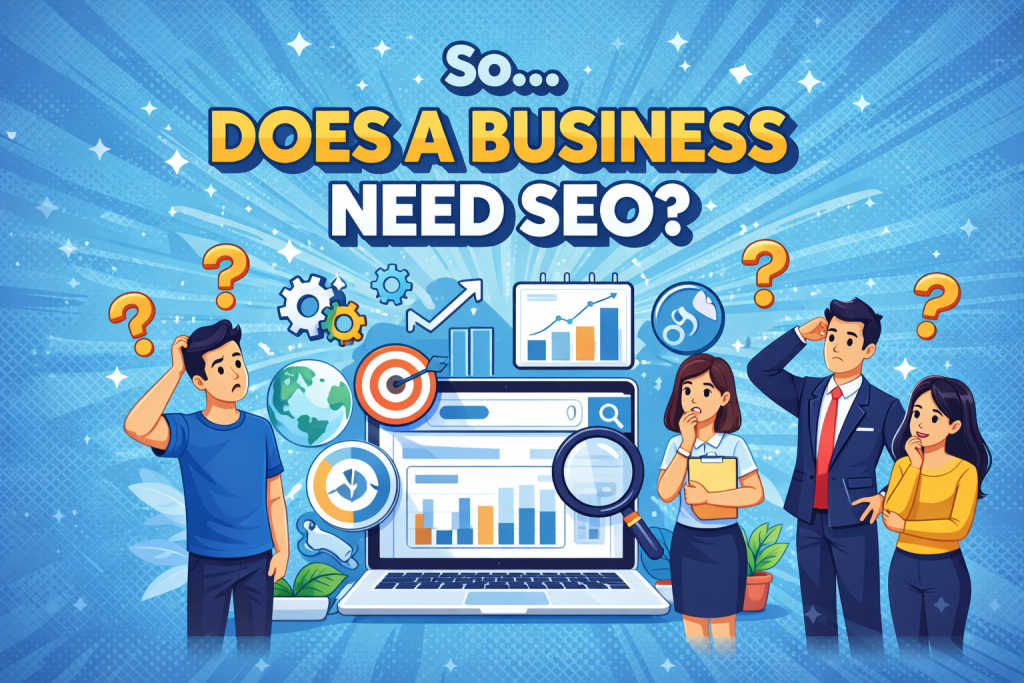
Yes — if your business wants visibility, trust, scalability, and long-term growth.
SEO is not a trend. It’s infrastructure. It’s how your business becomes discoverable in a world where nearly every buying decision starts with a search. Whether you are small, medium, or enterprise — SEO supports:
- Awareness
- Authority
- Acquisition
- And retention
Without it, you are building your business on rented land (ads, platforms, algorithms you don’t control). With SEO, you are building a digital asset you own.
Final Thoughts
So, does a business need SEO? Not because it’s fashionable — but because it’s foundational.
SEO connects your brand to people actively looking for solutions. It strengthens trust, reduces dependency on paid channels, and builds a long-term growth engine that compounds year after year.
In an era of AI, automation, and constant digital noise, SEO remains one of the few strategies that consistently rewards relevance, quality, and credibility. And that’s exactly what modern businesses need to grow — sustainably, predictably, and profitably.
Free Expert
Digital Marketing Consultation
Our expert digital marketing consultants offer you a no-risk marketing consultation that covers
Developing a tailored strategy to boost your leads and sales.
Uncovering the five key elements vital for digital marketing success.
See what your competitors are up to and learn how to beat them.