


SEO can become one of the most valuable long-term growth channels for a business. It helps potential customers discover your website when they are searching for information, products, services, or solutions related to what you offer.
However, one important question often appears after a business decides to invest in organic search:
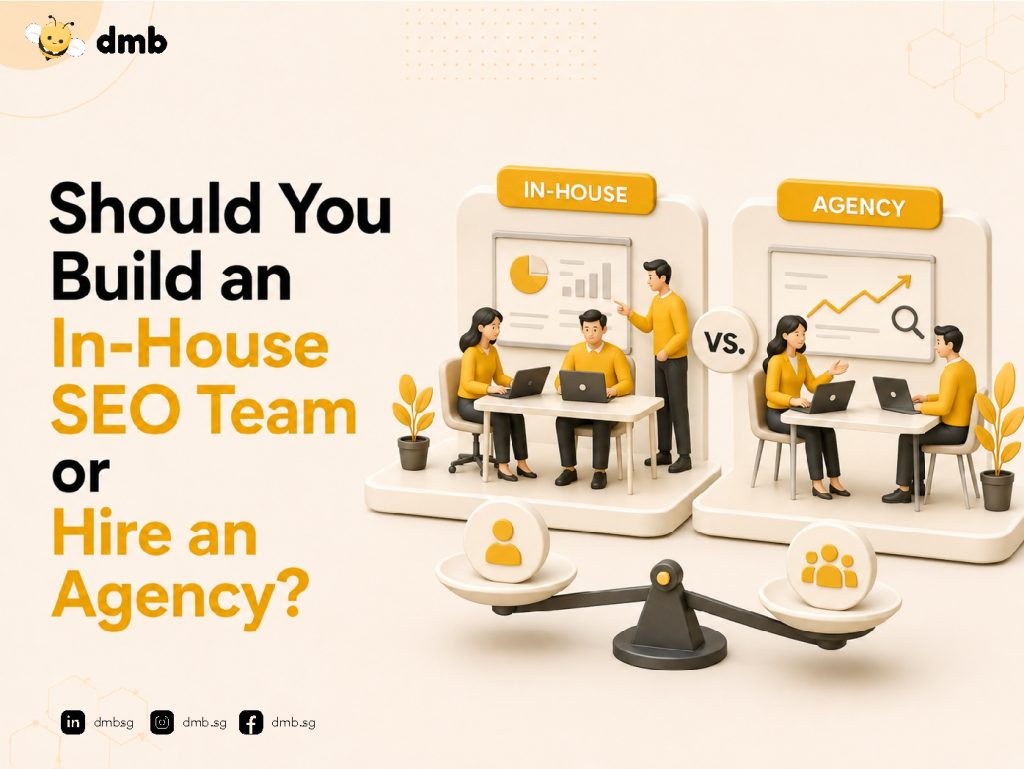
Should SEO be handled by an in-house team or an external agency?
There is no universal answer.
An in-house team can build deep product knowledge, work closely with sales and customer-facing departments, and respond quickly to internal priorities. On the other hand, an SEO agency can provide specialist expertise, established processes, broader technical exposure, and access to multiple skill sets without requiring a full internal hiring structure.
The best choice depends on the business stage, website complexity, available budget, internal capabilities, speed of execution, and level of strategic control required.
In a highly connected market, this decision matters. Customers increasingly research businesses before they contact a sales team, request a quotation, or make a purchase. Therefore, SEO should not be treated as a side task assigned to someone with spare time. It needs ownership, clear goals, consistent execution, and regular measurement.
This guide compares in-house SEO and agency SEO support so businesses can choose a model that fits both their current needs and long-term growth plans.
Why SEO Ownership Matters for Business Growth
SEO involves more than publishing blog posts or adding keywords to a page.
A complete SEO programme may include:
- Keyword and search-intent research
- Technical website audits
- Website structure and internal linking
- Content strategy and editorial planning
- Service-page optimisation
- Local SEO and Google Business Profile management
- Conversion improvement
- Competitor research
- Digital PR and authority building
- Reporting through Google Search Console and analytics
- Coordination with developers, designers, writers, and sales teams
This broad scope is why SEO ownership matters.
If nobody has clear responsibility for prioritising tasks, tracking progress, and aligning SEO activity with business goals, the work can become fragmented. Articles may be published without commercial purpose, technical issues may remain unresolved, and valuable search opportunities may be missed.
Therefore, the key decision is not simply whether to hire internally or externally. It is whether the chosen model can reliably manage the work required.
InHouse SEO: Control, Context, and Internal Collaboration
An in-house SEO setup means that SEO responsibilities are handled by employees within the business.
This may involve one SEO specialist, a digital marketing manager with SEO capability, a content team supported by technical staff, or a larger dedicated SEO department.
The biggest advantage of an internal team is context.
People inside the business usually understand the products, services, customer objections, internal priorities, brand voice, and sales process more deeply than an external partner can at the beginning.
Key Advantages of an In-House SEO Team
Stronger Product and Customer Knowledge
Internal teams often have direct access to sales calls, customer feedback, product updates, support tickets, and leadership discussions.
This can improve content quality because the team understands the questions customers actually ask.
For example, instead of creating generic articles about digital marketing, an internal team may identify that potential customers repeatedly struggle with lead quality, website conversion, or unclear positioning. These insights can become more relevant SEO content.
Faster Collaboration With Internal Teams
SEO often requires input from developers, designers, writers, sales teams, and product managers.
An in-house specialist may find it easier to coordinate changes such as:
- Updating service pages
- Fixing technical website issues
- Improving navigation
- Creating case studies
- Reviewing product information
- Adding conversion-focused calls to action
- Aligning content with sales priorities
This direct access can reduce delays.
Stronger Brand Consistency
Internal teams usually have a deeper understanding of tone of voice, brand positioning, compliance requirements, and customer expectations.
This is particularly valuable for businesses in technology, finance, professional services, healthcare, or regulated industries where inaccurate or overly broad claims can create risk.
Common Challenges of InHouse SEO
In-house SEO also comes with limitations.
A single employee may be expected to manage technical SEO, content planning, reporting, link-building, analytics, and campaign coordination at the same time. This can become overwhelming, especially when SEO is only one part of a broader digital marketing role.
Common challenges include:
- Limited specialist knowledge in technical SEO
- Difficulty hiring experienced SEO talent
- Overdependence on one employee
- Limited exposure to different industries and websites
- Lack of dedicated tools or data platforms
- Delays when developers have competing priorities
- Difficulty maintaining consistent content production
- Higher cost when a full internal team is required
An internal model works best when the business is ready to make SEO a meaningful operational priority rather than an occasional marketing activity.
SEO Agency Support: Specialist Capability and Scalable Execution
An SEO agency provides external support through a team of specialists.
Depending on the agency, this may include SEO strategists, technical specialists, content planners, copywriters, outreach teams, analysts, web developers, and account managers.
The main advantage is access to broader capability.
Rather than relying on one person to manage every SEO activity, a business can gain support from people with different areas of expertise.
Key Advantages of Hiring an SEO Agency
Access to Specialist Skills
SEO agencies may provide expertise across several disciplines:
- Technical audits
- Website migrations
- Crawlability and indexing issues
- Keyword research
- Content strategy
- Competitor analysis
- Link-building and digital PR
- Local SEO
- Search Console diagnostics
- Structured data
- Conversion-focused landing-page recommendations
This is valuable when a business has a complex website, multiple locations, an e-commerce catalogue, a planned redesign, or declining organic visibility.
Faster Access to Processes and Tools
Agencies often already have established workflows, reporting templates, audit frameworks, and SEO tools.
This can help businesses begin more quickly without building every process from scratch.
For example, an agency may already have systems for:
- Content-gap analysis
- Technical crawl reporting
- Keyword clustering
- Backlink monitoring
- Competitor tracking
- Monthly performance reviews
- Prioritisation frameworks
- Content briefs
This can be especially useful for businesses that need a clearer starting point.
Broader External Perspective
An agency may identify issues that an internal team has overlooked.
Because agencies work across multiple websites and industries, they may spot technical problems, content gaps, conversion barriers, or competitor patterns more quickly.
However, this advantage only matters when the agency takes time to understand the business instead of applying the same template to every client.
Common Challenges of Agency SEO
Agency support also requires careful management.
An external team may need time to understand the brand, customer journey, product details, internal approval process, and market context. Without clear communication, the work may become generic.
Common agency challenges include:
- Limited day-to-day access to internal knowledge
- Slower approvals for content and website changes
- Risk of receiving templated recommendations
- Reduced direct control over execution timing
- Communication gaps between agency, developer, and internal team
- Difficulty evaluating output if reporting is unclear
- Risk of choosing an agency based only on low pricing
An agency is not automatically the right choice simply because it has a larger team. The partnership must include clear goals, transparent reporting, realistic recommendations, and shared accountability.
In-House SEO vs Agency: A Practical Comparison
| Decision Factor | In-House SEO Team | SEO Agency |
| Product knowledge | Usually very strong | Requires onboarding and documentation |
| Technical capability | Depends on internal talent | Often broader and more specialised |
| Brand control | High | Shared with external partner |
| Speed of internal approvals | Usually faster | Can depend on client response time |
| Access to SEO tools | May require separate investment | Often included within service delivery |
| Cost structure | Salary, benefits, training, software | Retainer or project-based fees |
| Scalability | Requires hiring more people | Can expand support more quickly |
| External perspective | Can become internally focused | Often stronger competitor and market exposure |
| Website redesign support | May need outside specialists | Often suitable for audit and migration support |
| Long-term knowledge retention | Stays within the business | Requires documentation and knowledge transfer |
The comparison shows that neither model is automatically better.
The right model depends on what the business needs most: internal context, specialist skill, speed, control, scalability, or a combination of all five.
When an In-House SEO Team Is the Better Choice
In-house SEO may be the right option when the business has ongoing content needs, a growing website, and enough internal resources to support execution.
Consider building an internal team when:
- SEO is a core long-term acquisition channel
- The business publishes content regularly
- Product knowledge is complex or highly specialised
- Sales and customer teams generate valuable content insight
- There is a large website with frequent updates
- Developers and designers are available internally
- Brand compliance requires close review
- The business wants full ownership of strategy and execution
- There is enough budget for hiring, tools, training, and management
In-house SEO is particularly useful for companies with active product roadmaps, large content libraries, recurring launches, or complex customer journeys.
However, it should not mean assigning SEO to someone without sufficient time or training. A weak internal setup can create slower progress than a well-managed external partnership.
When an SEO Agency Is the Better Choice
An agency may be a stronger option when the business needs specialist guidance but does not yet require a full internal SEO department.
Consider hiring an agency when:
- The business has no dedicated SEO expertise
- The website has technical issues or declining visibility
- A redesign, migration, or new website launch is planned
- The team needs a clear SEO strategy and prioritised roadmap
- Content is being produced but not generating organic growth
- The business needs access to tools and specialist processes
- Internal marketing resources are limited
- The business wants an independent website or competitor audit
- SEO needs to scale faster than internal hiring allows
An agency can also be useful during specific high-impact moments, such as site migrations, e-commerce platform changes, large-scale content audits, or international expansion.
In these situations, agency experience may help reduce risk and accelerate decision-making.
The Hybrid SEO Model: Often the Most Practical Option
For many businesses, the strongest solution is not fully in-house or fully outsourced.
It is a hybrid model.
In a hybrid arrangement, the internal team owns brand knowledge, customer insights, approvals, and commercial priorities. Meanwhile, the agency supports specialist strategy, technical audits, content frameworks, performance analysis, and complex SEO projects.
A hybrid model may look like this:
| Internal Team Owns | Agency Supports |
| Product knowledge | Technical SEO audits |
| Customer insights | Keyword research and content strategy |
| Brand voice and approval | Competitor analysis |
| Sales alignment | Technical implementation recommendations |
| Case studies and proof | Site architecture and internal linking |
| Content subject-matter input | Measurement and reporting frameworks |
| Business priorities | Training and knowledge transfer |
This structure can create a healthier balance.
The business keeps strategic ownership, while the agency provides depth where specialist expertise is needed.
For growing companies, this may be more sustainable than immediately building a large internal team or handing all SEO decisions to an external provider.
How to Evaluate the Real Cost of SEO
The decision should not be based only on monthly fees.
An in-house employee may appear less expensive than an agency retainer at first. However, the full cost may include salary, benefits, recruitment, training, management time, software subscriptions, reporting tools, and the need for additional support in technical or content areas.
Similarly, an agency may appear expensive without considering the range of skills included in the service.
A more useful question is:
“What capability does this investment give us, and what business result should it support?”
Consider the total cost across:
- Strategy
- Technical SEO
- Content planning
- Writing and editing
- Design support
- Development support
- SEO tools
- Reporting
- Project management
- Training
- Quality assurance
The cheapest option may not be the most efficient. Likewise, the highest-priced option may not be valuable if the work is unclear or disconnected from business outcomes.
Questions to Ask Before Hiring an SEO Agency
Before choosing an agency, businesses should ask questions that reveal how the team works.
Useful questions include:
- Can you show relevant case studies or examples of previous work?
- How do you measure success beyond keyword rankings?
- What results are realistic, and what timeline should we expect?
- How do you approach technical SEO, content, and authority building?
- What work will be completed each month?
- Who will work on the account?
- What experience do you have in our industry?
- How do you handle website redesigns or migrations?
- How do you follow search-engine guidelines?
- What information or access do you need from our team?
- How will reporting connect SEO activity with leads or revenue?
- How will knowledge be transferred to our internal team?
Be careful with agencies that guarantee a number-one ranking, avoid explaining their methods, recommend large volumes of low-quality backlinks, or provide reports filled with metrics but no strategic explanation.
Strong SEO partners should be transparent about their process, assumptions, limitations, and priorities.
Measure SEO Performance Through Business Outcomes
Whether SEO is managed in-house or by an agency, the measurement framework should be the same.
The business needs to understand whether SEO is improving visibility, traffic quality, and commercial results.
Track metrics such as:
| SEO Objective | Useful Metrics |
| Search visibility | Impressions, average position, keyword coverage |
| Traffic growth | Organic users, sessions, landing-page visits |
| Content value | Engagement, scroll depth, return visits |
| Lead generation | Enquiries, form submissions, consultation bookings |
| Commercial impact | Qualified leads, pipeline value, assisted revenue |
| Technical health | Indexing issues, crawl errors, Core Web Vitals |
| Operational progress | Tasks completed, implementation rate, content output |
Google Search Console is especially useful because it can show which queries generate impressions and clicks, which pages attract search visitors, and where technical issues may be limiting performance.
The goal is not to receive a report every month.
The goal is to use data to make better decisions.
Choose the Model That Supports Execution, Not Just Planning
The question is not simply whether in-house SEO or agency SEO is better.
The better question is:
“Which model gives our business the right mix of expertise, context, speed, accountability, and capacity?”
An internal team may be ideal when SEO is a core growth channel and the company has enough scale to support dedicated talent. An agency may be the stronger choice when specialist support, technical depth, or faster execution is needed. For many businesses, a hybrid model provides the most balanced path.
Whichever option you choose, SEO should remain connected to customer needs, business priorities, technical health, useful content, and measurable outcomes.
A successful SEO programme is not defined by who performs the work.
It is defined by whether the work creates sustainable visibility, credible authority, and qualified business growth.
Free Expert
Digital Marketing Consultation
Our expert digital marketing consultants offer you a no-risk marketing consultation that covers
Developing a tailored strategy to boost your leads and sales.
Uncovering the five key elements vital for digital marketing success.
See what your competitors are up to and learn how to beat them.