


If you run a business or manage digital marketing, you know that a website isn’t “set and forget.” Rather, it requires regular health checks. That’s where a SEO audit checklist comes in: a structured, comprehensive evaluation to spot problems, optimize performance, and ensure long-term search visibility. In this article, you’ll get a full checklist, from technical infrastructure to content, links, to analytics, plus how and why to use it.
What Is an SEO Audit and Why It Matters
An SEO audit is a systematic process that evaluates how well your website aligns with search engine best practices and flags issues that may be limiting your visibility.
In practice, audit helps you to:
- Identify technical problems (speed, indexing, crawlability)
- Ensure on-page elements (titles, meta, structure) are optimized
- Review content quality & relevance for user intent
- Inspect off-page signals (backlinks, domain authority)
- Benchmark current performance and plan future optimizations
Without regular audits, even well-built websites may accumulate hidden issues over time, from broken links to slow pages or outdated content, which can silently drag down performance.
Thus, think of an SEO audit checklist as a recurring “health check” for your digital asset.
What Makes a Good SEO Audit Checklist
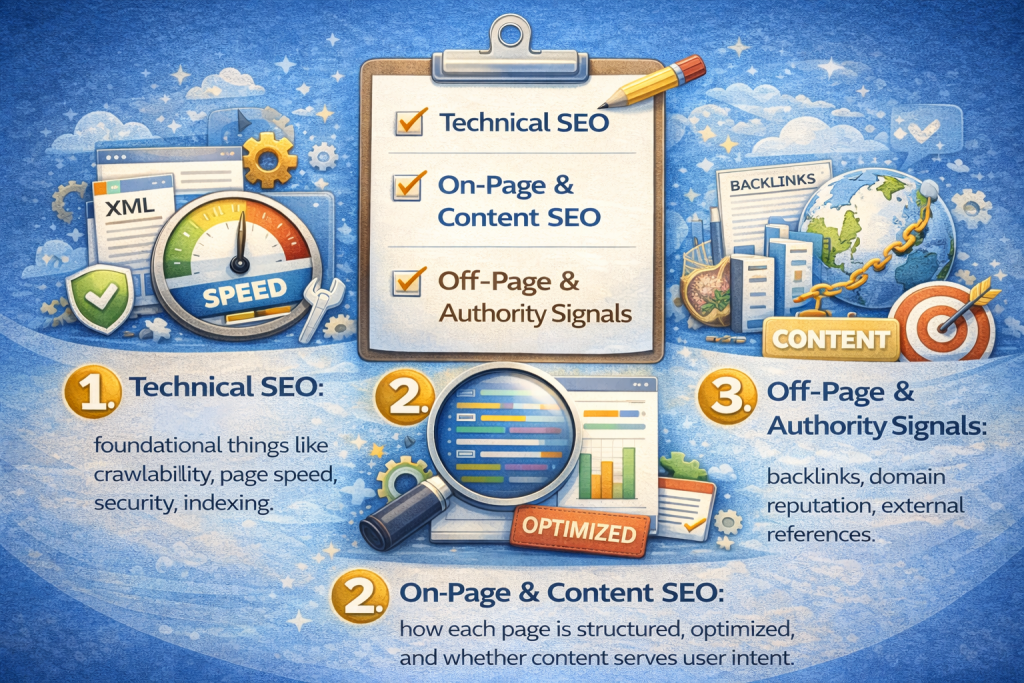
A robust checklist should cover three main layers:
- Technical SEO: foundational things like crawlability, page speed, security, indexing.
- On-Page & Content SEO: how each page is structured, optimized, and whether content serves user intent.
- Off-Page & Authority Signals: backlinks, domain reputation, external references.
Also, it’s useful to include analytics review, to measure performance before and after optimizations, so you know whether changes are effective.
Moreover, a good checklist is actionable and prioritized: not all issues are equal. Some fixes may be critical (e.g. crawl errors), others more “nice to have.” A tiered checklist helps you tackle the most impactful problems first.
SEO Audit Checklist: Detailed Step-by-Step
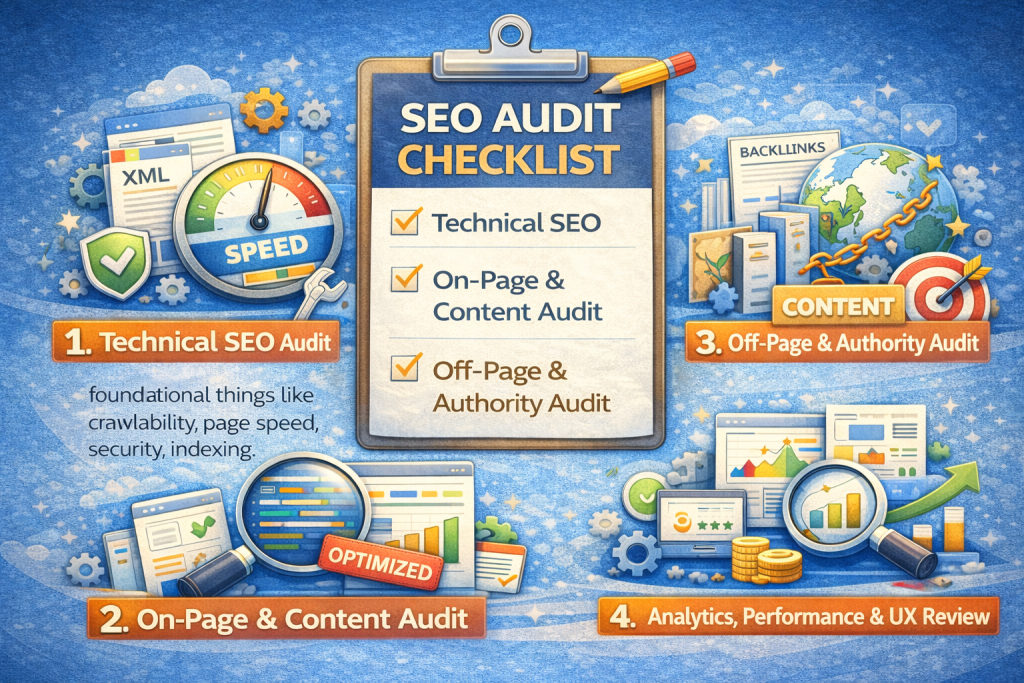
1. Technical SEO Audit
Start here, because if the foundation is weak, other optimizations may fail.
- Run a full site crawl. Use tools like Ahrefs, Screaming Frog SEO Spider, or similar to scan for broken links, duplicate content, missing meta tags, redirect issues, crawl errors.
- Check indexing & crawlability. Verify via tools such as Google Search Console (GSC) that important pages are indexed and there are no unintended blocks (robots.txt, no-index, canonical issues).
- Ensure the site uses HTTPS. Security and trust matter, HTTPS is a standard.
- Test mobile-friendliness. Since many users browse on mobile, ensure your site is responsive and usable on small screens.
- Measure page speed / performance. Use tools like PageSpeed Insights or similar to ensure load times are optimized, slow pages hurt both user experience and SEO.
- Review site architecture & URL structure. Ensure clean, SEO-friendly URLs, logical hierarchy, proper internal linking, and working sitemap/robots.txt.
- Crawl error / broken link check. Identify 404s, broken media, redirect loops and fix them to avoid wasted crawl budget or poor UX.
- Check canonicalization & duplicate content. Make sure canonical tags are used correctly; avoid duplicate pages that compete with each other.
2. On-Page & Content Audit
Once the technical foundation is solid, focus on what users (and search engines) see.
- Title tags & meta descriptions. Ensure each page has a unique, keyword-optimized title (within 50-60 char) and a compelling meta description (~155-160 char) to improve click-through rates.
- Heading structure (H1, H2, H3…). Use a clear heading hierarchy, one H1 per page, supporting sub-headings, to make content scannable and SEO-friendly.
- Content quality & relevance. Content should satisfy user intent: informative, original, up-to-date, and ideally better than competitors’. Avoid thin or duplicated content.
- Optimize images & media. Use descriptive alt text, compressed images, proper file names; this helps both SEO and performance.
- Internal linking. Link related pages logically to spread link equity, improve navigation, and help indexing.
- URL slugs / structure. Use clean, readable URLs, avoid long query strings or confusing parameters.
- Content freshness & formatting. Update older content, ensure readability, use bullet/number lists, images, spacing, all help user engagement and SEO.
3. Off-Page & Authority Audit
Beyond your site: what cues does the web give to search engines about your domain’s authority?
- Backlink profile analysis. Review which domains link to you: are they authoritative and relevant? Identify toxic or spammy links for removal or disavow.
- Brand mentions and external references. Monitor whether your brand is mentioned or discussed elsewhere, social media, blogs, news, as these can contribute to trust and authority.
- Competitor comparison & gap analysis. Review what competitors rank for, their backlinks, content, and find opportunities where you can outperform them.
- Off-site signals (if relevant): directory listings, local SEO, citations, if applicable to your business.
4. Analytics, Performance & UX Review
SEO isn’t only about ranking, it’s about performance and user experience.
- Check organic traffic & performance metrics. Use analytics tools to see organic search as a traffic source, monitor trends over time.
- User behavior metrics (bounce, time on page, conversion rate). High bounce or low conversion may signal UX/content issues. Adjust accordingly.
- Prioritize issues & plan fixes. Use a spreadsheet or audit tool to assign priority (critical, high, medium, low), this helps you act systematically.
- Schedule regular audits. For dynamic sites or large businesses, conduct a full audit every 3–6 months; for smaller/stable sites, at least twice a year.
How to Use This Checklist
- Gather baseline data. Run a crawl, export existing site data, get analytics snapshot.
- Perform technical audit first. Fix critical issues: indexability, speed, mobile, security.
- Move to on-page & content audit. Optimize titles, content, structure, links.
- Then check off-page / authority factors. Audit backlinks, external presence, brand mentions.
- Review analytics & performance. Compare before vs after data to measure impact.
- Prioritize & plan. Use a document (spreadsheet or project management tool) to track issue, priority, responsible person, status.
- Repeat periodically and after major changes. Website redesign, move server, big content update — audit again to avoid new issues.
Common Mistakes to Avoid
- Focusing only on content while ignoring technical issues, even great content fails if the site is not crawlable.
- Ignoring user experience, SEO is not just for crawlers but also for real users.
- Not tracking changes, without data, you can’t measure the impact of your optimizations.
- Doing all fixes at once, better to prioritize and roll out incrementally to monitor effects.
- Forgetting off-page & authority signals, backlinks, brand mentions, external presence matter for long-term ranking power.
Summary
A well-structured SEO audit checklist helps you:
- Reveal hidden problems that hurt visibility and performance.
- Build a stable, SEO-friendly website with optimized content & technical health.
- Strengthen your site’s authority and competitiveness.
- Create a repeatable process for maintenance and improvement.
- Align SEO works with business goals (traffic, leads, conversions) in a measurable way.
In short, an SEO audit checklist isn’t optional; it’s essential for any serious digital marketing effort.
Closing Thoughts
In today’s competitive digital landscape, a website is more than a digital storefront, it’s a core asset. And like any asset, it needs regular check-ups. By using the SEO audit checklist above, you can systematically examine, fix, and optimize your website, ensuring it’s healthy, fast, user-friendly, and primed to rank.
Therefore, don’t wait until traffic drops or conversions fall. Grab this checklist, run your audit, fix what needs attention, monitor performance and build a website that not only ranks, but also drives real business value. Good luck!
Free Expert
Digital Marketing Consultation
Our expert digital marketing consultants offer you a no-risk marketing consultation that covers
Developing a tailored strategy to boost your leads and sales.
Uncovering the five key elements vital for digital marketing success.
See what your competitors are up to and learn how to beat them.