


If you’re managing a website for business or digital marketing, understanding which metrics to track is vital. With so many numbers in tools like Google Analytics or Search Console, it’s easy to get lost. That’s why knowing the key SEO metrics helps you focus on what truly signals performance and health. In this article, we’ll walk through the most important metrics, explain what they reveal, and how to use them to steer your SEO efforts smartly.
What Are SEO Metrics (or KPIs)?
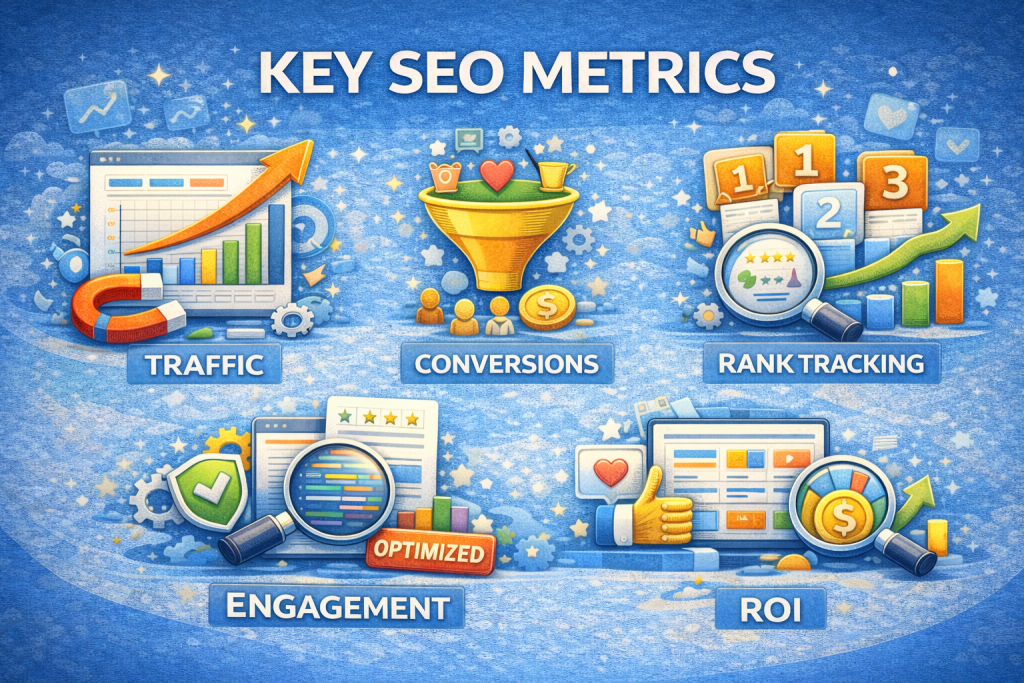
SEO metrics, sometimes called SEO KPIs are measurable data points that indicate how well your website is performing in search engines and how effectively it converts visitors into users, leads, or customers. Essentially, they tell you whether your SEO work is working.
However, not all metrics are equally meaningful. Some give direct insights into search visibility and user behaviour, while others — though potentially interesting may be “vanity metrics” unless tied to business goals.
Therefore, to make SEO decisions confidently, it’s good to focus on key metrics that matter for traffic, engagement, conversions, and site health.
12 Key SEO Metrics You Should Track
Here are the most important metrics you should monitor — especially if you aim for sustainable growth and measurable results.
1. Organic Traffic
What it means: number of visits coming from search engines (unpaid).
Why it matters: Organic traffic shows how visible your site is in search results. If traffic increases over time, it indicates your content and SEO are performing.
How to track: use tools like Google Analytics (set segment “Organic Traffic”) or Search Console to monitor trend over time.
2. Keyword Rankings (or Number of Ranking Keywords)
What it means: how many and which keywords your pages rank for in SERPs, and their positions.
Why it matters: Rankings influence visibility and potential traffic. More keywords or better positions usually lead to more visits and opportunities.
How to track: use rank-tracking tools (or Search Console data) to log positions for target keywords, and monitor changes over time.
3. Organic Click-Through Rate (CTR)
What it means: ratio of users who click on your link in search results compared to number of impressions.
Why it matters: A high CTR means your title, meta description, and snippet are compelling and relevant. Even if you rank well, a low CTR signals a mismatch between what users expect and what you offer.
How to track: use Search Console, monitor impressions vs clicks for pages or queries.
4. Organic Conversion Rate ( or Organic Conversions / Leads / Sales )
What it means: percentage of organic visitors who complete a desired action (purchase, signup, download).
Why it matters: Traffic alone doesn’t guarantee success — conversions show real value. This metric ties SEO directly to business outcomes and ROI.
How to track: define goals or conversions in Google Analytics (or other analytics tools), and segment conversions from organic traffic.
5. Bounce Rate & Exit Rate
What it means: bounce rate is % of visitors leaving after viewing only one page; exit rate is % leaving after a certain page.
Why it matters: High bounce or exit rates might signal poor user experience, irrelevant content, or mismatch with user intent. This helps you spot pages needing improvement.
How to track: in analytics tools, filter by organic traffic and inspect page-by-page bounce/exit rates.
6. Pages per Session & Session Duration (Engagement Metrics)
What it means: how many pages a user visits per session, and how long they stay on site.
Why it matters: More pages per session or longer session duration generally indicate deeper engagement and interest, good signals for both SEO and conversions.
How to track: Google Analytics → Behavior reports (Pages per session, Avg. Session Duration).
7. Page Load Speed & Core Web Vitals / Site Performance Metrics
What it means: site loading time, mobile-friendliness, user experience metrics (e.g. layout stability, interactivity).
Why it matters: Search engines use page speed and user experience as ranking signals; slow sites cause high bounce, poor UX, lower rankings.
How to track: tools like Google PageSpeed Insights, Lighthouse; monitor Core Web Vitals via Search Console.
8. Backlink Metrics & Referring Domains / Domain Authority (or Equivalent)
What it means: number and quality of external sites linking to your pages, and overall domain strength.
Why it matters: Backlinks from authoritative, relevant sites boost your site’s credibility, trustworthiness, and ranking potential.
How to track: SEO tools like Ahrefs, SEMrush, Moz, etc., to audit backlinks and referring domains.
9. Search Visibility / Share of Voice / Impressions in SERPs
What it means: measure of how often your site appears in search results for tracked keywords (even if not clicked).
Why it matters: Visibility shows potential reach and dominance relative to competitors, a good indicator of brand presence and growth potential.
How to track: through rank-tracking tools or Search Console “impressions” data.
10. Indexed Pages / Crawl Coverage & Technical Health
What it means: number of your pages properly indexed and their technical status (errors, redirects, crawlability).
Why it matters: If pages aren’t indexed or have crawl issues, they won’t appear in search, no matter how great your content is. This impacts long-term SEO sustainability.
How to track: use Google Search Console (Coverage report), SEO audit tools or site crawlers.
11. Mobile Traffic Share & Device-Based Performance
What it means: proportion of visitors using mobile devices, and how your site performs on mobile.
Why it matters: As many users browse via mobile, a mobile-friendly and fast site ensures good UX and ranking in mobile searches.
How to track: Google Analytics → Audience → Mobile; PageSpeed / Mobile usability tools for performance.
12. SEO ROI / Value (Economic Value, Cost Saved vs PPC, or Revenue from Organic)
What it means: measure of actual return or value derived from SEO, e.g. revenue from organic conversions, cost saved by organic vs paid ads.
Why it matters: This transforms SEO from a “nice to have” into a business metric. It helps justify investment and guides decision-making.
How to track: combine conversion data, revenue tracking, audit costs (time, tools), and compare against paid alternatives.
How to Use These Key SEO Metrics Effectively
1. Align Metrics to Business Goals
Not all metrics matter equally — what matters depends on your business objective. If you aim for brand awareness, prioritize visibility, impressions, and traffic. If you focus on sales or leads, emphasize conversions, organic conversion rate, ROI.
2. Use Tools That Provide Reliable Data
Combine analytics (e.g. Google Analytics, Search Console) with SEO tools (rank tracker, backlink analyser, performance tools) to get a full picture.
3. Track Over Time & Look for Trends, Not Just Spikes
Weekly or monthly snapshots can fluctuate, focus on long-term trends (growth in traffic, improvement in rankings, consistent conversions).
4. Segment Data for Clarity
Filter metrics by organic traffic, by device (mobile/desktop), by region, or by content type. This helps identify problems or opportunities in detail.
5. Prioritise Optimization Based on Impact
Use the metrics to prioritise: for example, slow page speed or poor mobile usability, fix those first before focusing on backlinks or content, because technical issues affect everything else.
Common Pitfalls & What to Avoid
- Focusing only on “vanity metrics” (e.g. total page views, time on page) without evaluating conversion or business results. Metrics are only useful when tied to business goals.
- Chasing low rankings for non-target keywords, leading to irrelevant traffic. Instead, focus on keyword relevance & user intent.
- Over-optimizing for metrics without considering user experience (e.g. speed vs heavy functionality).
- Ignoring mobile performance, in markets where many users are on mobile, this can hurt both UX and SEO.
- Not combining metrics, e.g. high traffic but low conversions may signal mismatch; high bounce but high page views may signal navigation issues.
How to Monitor Key SEO Metrics
- Setup baseline: run full analytics report, record current key metrics.
- Define KPIs: decide which metrics align with business goals (awareness, lead, sales).
- Choose tools & dashboards: set up Google Analytics, Search Console, rank tracker, performance tools.
- Monitor regularly: monthly (major metrics), weekly (for issues), quarterly (deep analysis).
- Analyze & segment data: by traffic source, by device, by content type.
- Report & adjust strategy: use insights to optimize content, technical setup, UX, conversion flows.
- Review ROI: measure SEO investment vs results (organic conversions, revenue, cost saved).
Why These Key SEO Metrics Matter for Businesses & Marketers
For business owners and digital marketers, these key SEO metrics do more than track performance: they help:
- Translate SEO efforts into business outcomes (leads, revenue)
- Prioritize resources based on data (which pages to fix, which content to create)
- Demonstrate ROI of SEO work to stakeholders or clients
- Spot issues early, technical, content or UX issues before they harm traffic or brand reputation
- Build sustainable organic growth, through consistent monitoring and optimization
Last but Not Least
In a rapidly evolving search landscape, data-driven decisions are more vital than ever. By tracking the key SEO metrics outlined above, you gain clarity on what works and what needs improvement. Rather than guesswork, metrics give you evidence, which means better strategies, smarter optimizations, and stronger business results.
So start tracking. Set your KPIs. Monitor regularly. Then iterate based on what the data tells you. Your SEO efforts will be sharper, your results more impactful and over time, your website will transform from a simple presence into a powerful asset for growth and success.
Frequently Asked Questions
What are SEO metrics?
SEO metrics are measurable data points used to evaluate how well a website performs in search engines. They help marketers understand whether their SEO strategies are increasing visibility, organic traffic, and conversions.
What are the most important SEO metrics to track?
Some of the most important SEO metrics include organic traffic, keyword rankings, click-through rate (CTR), backlinks, and conversion rate. These metrics help measure search visibility, user engagement, and the effectiveness of SEO strategies.
Why are SEO metrics important?
SEO metrics are important because they provide measurable insights into how well a website performs in search engines. By tracking these metrics, businesses can evaluate SEO performance, identify opportunities for improvement, and demonstrate the ROI of their SEO efforts.
[popup_anything id="9890"]
Free Expert
Digital Marketing Consultation
Our expert digital marketing consultants offer you a no-risk marketing consultation that covers
Developing a tailored strategy to boost your leads and sales.
Uncovering the five key elements vital for digital marketing success.
See what your competitors are up to and learn how to beat them.