


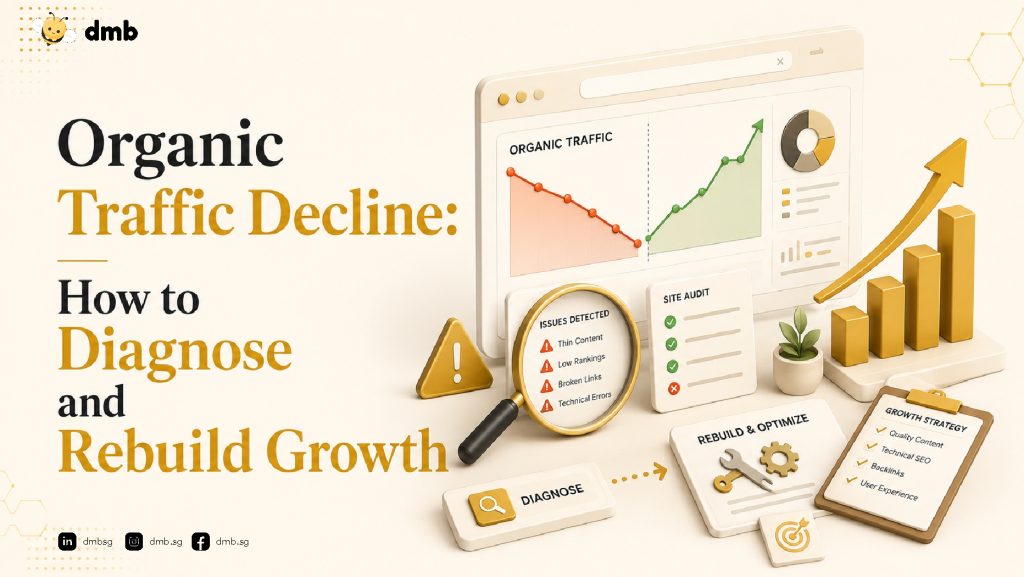
A drop in organic traffic can feel alarming. One month, your website is getting steady visitors from Google. The next month, traffic falls, enquiries slow down, and the sales team starts asking what happened. For business owners and marketing managers, this can quickly become stressful because organic traffic often supports long-term growth, lead generation, brand visibility, and lower customer acquisition costs.
However, a traffic drop does not always mean your website has been penalised. It does not always mean your SEO agency failed. It also does not always mean your content is suddenly bad. Organic traffic can drop for many reasons: Google updates, ranking shifts, technical issues, tracking changes, search behaviour changes, stronger competitors, lower demand, seasonality, content decay, website migration mistakes, or even changes in how search results are displayed.
In 2026, the situation is even more complex. Search is no longer only a list of blue links. Google now includes AI Overviews, featured snippets, People Also Ask boxes, local packs, shopping results, videos, ads, forums, and other rich result formats. As a result, even websites that still rank on page one may receive fewer clicks than before.
Google Search Central explains that Google Search results are dynamic because user expectations evolve and the open web constantly changes. This means both traffic gains and traffic drops can happen even when a website has not done anything obviously wrong. Google also recommends using Search Console, Google Trends, and traffic pattern analysis to diagnose what caused the drop.
For businesses that depend on organic traffic, the best response is not panic. The best response is diagnosis. Before changing pages, deleting content, redesigning the website, or shifting the entire budget to paid ads, you need to understand why the traffic is dropping.
This article explains the most common reasons organic traffic drops, how to investigate the issue, and how businesses can rebuild growth with a stronger SEO and paid media strategy.
Why Organic Traffic is Dropping: The Short Answer
Organic traffic usually drops because fewer people are reaching your website from unpaid search results. That can happen for several reasons.
Some causes are external, such as Google algorithm updates, AI-generated search answers, seasonality, or changing search demand. Other causes are internal, such as technical SEO problems, content quality issues, website migration errors, lost backlinks, poor page experience, or inaccurate analytics tracking.
The key is to identify whether the problem is:
- A ranking problem
- A click-through rate problem
- An indexing problem
- A demand problem
- A tracking problem
- A technical problem
- A content quality problem
- A search results layout problem
For example, if rankings are stable but clicks are falling, the issue may be lower click-through rate caused by AI Overviews, ads, featured snippets, or stronger SERP competition. If impressions are falling, demand may be lower or rankings may have dropped. If traffic drops suddenly after a website update, the issue may be technical. If only one section of the website is affected, the problem may be content-specific.
In other words, the first step is not “fix SEO.” The first step is to understand which part of the organic search system has changed.
Organic Traffic vs Rankings: Why They Are Not the Same
Many businesses assume that if rankings are good, traffic should be good. Unfortunately, this is not always true.
A website may still rank on page one but receive fewer clicks because the search results page has changed. For example, the query may now show more ads, a local map pack, AI Overviews, videos, shopping results, or People Also Ask boxes above the organic listings.
How This Affects Business Websites
If your page used to rank position three and receive steady clicks, but Google now shows a large AI Overview, four ads, and a local pack above your listing, your actual visibility may decline even if your ranking number looks similar.
This is why businesses should not only track keyword positions. They should also track:
- Impressions
- Clicks
- Click-through rate
- Average position
- Query-level performance
- Landing page performance
- Search result features
- Branded vs non-branded traffic
- Desktop vs mobile traffic
- Country or location-level traffic
Example Scenario
A service page ranks in position four for a high-intent keyword. Previously, it received 300 clicks per month. After the search results changed, it still ranks position four but receives only 150 clicks per month. The ranking did not collapse, but traffic dropped by 50%.
What This Means: The problem is not always the page itself. The problem may be that the search result page is now more crowded.
Business Takeaway: SEO performance should be analysed by visibility, clicks, and conversions, not rankings alone.
1. Google Core Updates Can Change Organic Traffic
One of the most common reasons organic traffic drops is a Google core update.
Google makes broad changes to its search algorithms and systems several times per year. These are called core updates. According to Google Search Central, core updates are designed to improve how Google assesses content overall, and they may cause some pages to perform better while others perform worse.
The Google Search Status Dashboard shows multiple ranking updates across 2025 and 2026, including the May 2026 core update, March 2026 core update, March 2026 spam update, and earlier 2025 core and spam updates.
How Core Updates Affect Websites
A core update can affect:
- Informational articles
- Product pages
- Service pages
- Local business pages
- Review content
- Affiliate content
- AI-generated content
- Thin or outdated content
- Pages with weak expertise signals
However, a drop after a core update does not automatically mean your website violated Google’s policies. Google has repeatedly explained that core updates are not necessarily penalties. Instead, they may reflect changes in how Google evaluates content relevance, usefulness, quality, and overall search satisfaction.
What to Check After a Core Update
If your traffic drops after a core update, review:
- Which pages lost traffic
- Which queries declined
- Whether the decline happened during the update window
- Whether competitors gained traffic
- Whether the content is still accurate
- Whether the page provides original value
- Whether the author or company expertise is clear
- Whether the content satisfies search intent better than competing pages
A good recovery strategy should focus on improving usefulness, depth, trust, and relevance rather than making random keyword changes.
2. AI Overviews and Zero-Click Search May Reduce Clicks
Another major reason organic traffic may drop is that users are getting answers directly on the search results page.
Google’s AI features, including AI Overviews and AI Mode, are changing how people interact with search. Google says AI Overviews provide a snapshot of key information with links to explore more on the web. However, from a business perspective, the concern is clear: if users get enough information from the search results page, they may not click through to websites.
SparkToro’s 2024 zero-click search study found that a large share of Google searches end without a click to the open web. Search Engine Land’s summary of the study reported that 58.5% of Google searches in the U.S. and 59.7% in the EU resulted in zero clicks.
More recent academic research on AI Overviews also suggests that AI-generated answers can reduce traffic for certain informational publishers. One 2026 study on Google AI Overviews and Wikipedia found that exposure to AI Overviews reduced daily traffic to English Wikipedia articles by approximately 15% across the studied dataset.
What This Means for Business SEO
This does not mean SEO is dead. It means informational SEO needs to evolve.
Basic definitions, simple explanations, and short-answer content may receive fewer clicks if Google can answer the query directly. However, users may still click when they need:
- Deeper analysis
- Expert guidance
- Comparison
- Practical templates
- Local service options
- Case studies
- Pricing context
- Tools or calculators
- Step-by-step implementation
- Business-specific recommendations
Therefore, businesses should move beyond shallow content and build pages that give users a reason to click.
3. Search Intent May Have Changed
Search intent is the reason behind a search query. When organic traffic drops, the intent behind a keyword may have shifted.
For example, a keyword that once showed blog articles may now show product pages. A query that once showed service providers may now show comparison websites. A keyword that once showed local businesses may now show videos, forums, or AI answers.
Common Search Intent Shifts
A query may shift from:
- Informational to commercial
- Commercial to transactional
- Text-based results to video results
- National results to local results
- Blog content to forum discussions
- Organic pages to AI summaries
- Product listings to marketplace results
If your page no longer matches the dominant search intent, rankings and clicks may drop.
How to Diagnose Search Intent Problems
Search your target keyword manually and compare the current top results. Look at what Google is rewarding now.
Ask:
- Are the top pages still articles?
- Are they service pages?
- Are they ecommerce pages?
- Are they local map results?
- Are they comparison guides?
- Are they forum discussions?
- Are videos appearing more prominently?
- Are AI Overviews answering the query?
If the search result page changed, your content may need to be repositioned.
4. Content Decay Can Slowly Reduce Organic Traffic
Not every traffic drop is sudden. Sometimes traffic declines slowly over several months. This is often caused by content decay.
Content decay happens when a page becomes less competitive over time. The topic may still be relevant, but the page may no longer be the best answer available.
Why Content Decay Happens
Content may decay because:
- Statistics become outdated
- Competitors publish better guides
- Search intent changes
- Internal links weaken
- The page becomes too thin
- The title no longer matches user expectations
- The content lacks examples
- The page has no fresh perspective
- The topic becomes more competitive
For example, an article about “Google Ads strategy” written in 2022 may not fully reflect Performance Max, AI bidding, privacy changes, and current measurement challenges. Even if the article was strong when published, it may lose traffic if it is not updated.
How to Fix Content Decay
Update the page with:
- Current data
- Better examples
- Stronger headings
- More practical steps
- Clearer search intent alignment
- Expert commentary
- Improved internal links
- Better meta title and meta description
- More useful visuals
- Updated FAQs
- Stronger E-E-A-T signals
The goal is not simply to change the date. The goal is to make the page genuinely more useful.
5. Technical SEO Issues Can Block Organic Growth
Sometimes organic traffic drops because search engines cannot crawl, index, or understand the website properly.
Technical issues can happen after website redesigns, CMS updates, plugin changes, server problems, migrations, or accidental configuration changes.
Common Technical SEO Problems
Check for:
- Pages accidentally set to no-index
- Robots.txt blocking important pages
- Canonical tags pointing to the wrong URL
- Broken redirects
- 404 errors
- Slow server response
- Poor mobile usability
- JavaScript rendering problems
- Duplicate content
- Sitemap errors
- Internal links removed
- HTTPS problems
- Soft 404 pages
- Incorrect hreflang implementation
Google Search Central recommends using Search Console to investigate indexing, crawling, and performance drops. This is important because technical problems can make strong content invisible.
When Technical Issues Are Likely
Technical SEO should be checked first if traffic drops after:
- A website migration
- A theme change
- A URL structure change
- A CMS update
- A hosting change
- A domain change
- A redesign
- A plugin installation
- A staging site mistake
- A developer deployment
If the timing matches a website change, do not assume the problem is content quality. It may be technical.
6. Tracking and Analytics Changes Can Create False Drops
Sometimes organic traffic looks like it is dropping, but the website is actually experiencing a tracking issue.
This can happen when analytics tags are removed, cookie banners block tracking, GA4 settings change, consent mode is misconfigured, or traffic is being classified differently.
Signs of a Tracking Problem
You may have a tracking issue if:
- All channels drop at the same time
- Traffic drops exactly after a website update
- Google Search Console clicks are stable but GA4 organic sessions drop
- Conversions disappear suddenly
- Only certain pages stop tracking
- Events stop firing
- Tag Manager changes were made recently
This is why businesses should compare Google Search Console with GA4. Search Console shows clicks from Google Search, while GA4 shows website sessions and user behaviour after the click. If Search Console is stable but GA4 drops, tracking may be the problem.
7. Competitors May Have Improved Their SEO
Organic traffic is competitive. A drop in your traffic may happen because competitors improved their content, backlinks, page experience, topical authority, or overall search presence.
SEO is not static. If your website stays the same while competitors keep improving, your relative position may decline.
What Competitors May Be Doing Better
Competitors may have:
- Published more comprehensive content
- Improved service pages
- Built stronger internal linking
- Earned higher-quality backlinks
- Added case studies
- Improved page speed
- Updated old articles
- Added expert authors
- Built better local SEO signals
- Improved conversion-focused design
To recover, you need to compare your pages against the current winners, not against your own past version.
8. Paid Ads and SERP Features May Push Organic Results Lower
Organic traffic can also drop when paid ads or search features take more space above organic listings.
For commercial keywords, Google may show several ads before organic results. It may also show local packs, shopping results, review snippets, People Also Ask, videos, or AI Overviews.
Why This Matters for Businesses
If your business depends on high-intent service keywords, organic SEO alone may not capture all available demand. Users may click paid ads before reaching organic results, especially on mobile where screen space is limited.
This is where Google Ads can support organic strategy. Paid search can help capture demand while SEO builds long-term visibility. However, ads should not replace SEO completely. A strong strategy uses both.
9. Your Content May Lack E-E-A-T Signals
Google Search Central encourages site owners to create helpful, reliable, people-first content. It also explains that content quality can be evaluated through experience, expertise, authoritativeness, and trustworthiness, often known as E-E-A-T.
If your content is generic, thin, copied, outdated, or written without clear expertise, it may struggle to maintain organic visibility.
E-E-A-T Signals to Improve
Strengthen your pages with:
- Clear author information
- Company expertise
- Real examples
- First-hand experience
- Case studies
- Original insights
- Credible references
- Updated data
- Transparent service process
- Clear contact details
- Privacy and trust pages
- Helpful internal links
- Accurate claims
For business and digital marketing websites, E-E-A-T is especially important because readers want advice they can trust before making budget decisions.
How to Diagnose an Organic Traffic Drop Step by Step
A structured diagnosis helps avoid random fixes.
1. Confirm the Drop
Check whether the drop appears in both Google Search Console and GA4.
Look at:
- Total clicks
- Total impressions
- Organic sessions
- Organic conversions
- Landing pages
- Queries
- Countries
- Devices
2. Identify the Pattern
Ask:
- Did the drop happen suddenly or gradually?
- Did it affect the whole site or specific pages?
- Did branded traffic drop or only non-branded traffic?
- Did impressions drop or only clicks?
- Did rankings drop or only CTR?
- Did the drop happen after a website change?
- Did the drop happen during a Google update?
3. Segment the Data
Break down the data by:
- Page type
- Topic cluster
- Keyword intent
- Device
- Country
- Date range
- Branded vs non-branded queries
- New vs returning users
4. Check Technical Health
Review:
- Indexing status
- Crawl errors
- Sitemap
- Robots.txt
- Canonicals
- Redirects
- Page speed
- Mobile usability
- Core Web Vitals
- Broken pages
5. Review Content Quality
For affected pages, ask:
- Is the content still accurate?
- Does it match current search intent?
- Is it better than competing pages?
- Does it show expertise?
- Does it include current data?
- Does it answer the query deeply?
- Does it have a clear next step?
6. Check SERP Changes
Search the affected keywords and review the current results.
Look for:
- AI Overviews
- Ads
- Local packs
- Videos
- People Also Ask
- Featured snippets
- Forum results
- Shopping results
- Competitor changes
7. Build a Recovery Plan
Once the cause is clear, prioritise fixes based on impact.
How to Recover Organic Traffic
Traffic recovery takes time, but a focused plan can help.
Improve High-Value Pages First
Do not update every page at once. Start with pages that previously drove leads, revenue, or high-quality traffic.
Refresh Content With Real Value
Add new data, better examples, expert insights, improved structure, and clearer explanations.
Strengthen Internal Links
Internal links help users and search engines understand your content hierarchy. Link from strong pages to important service pages and updated articles.
Improve Technical SEO
Fix indexing, redirects, speed, mobile issues, duplicate content, and crawl problems.
Optimise for Click-Through Rate
Improve meta titles and descriptions. Make them specific, useful, and aligned with search intent.
Build Better Conversion Paths
If traffic is lower, every visitor matters more. Improve forms, CTAs, landing pages, trust signals, and lead capture.
Use Paid Media Strategically
If organic traffic is dropping from high-intent keywords, Google Ads can help protect lead flow while SEO recovery is in progress.
Use paid media to:
- Capture urgent demand
- Test messaging
- Promote high-converting landing pages
- Retarget website visitors
- Support new content campaigns
- Fill gaps during SEO recovery
This does not mean abandoning SEO. It means using paid media as a support system while organic visibility rebuilds.
Conclusion
Organic traffic drops can happen for many reasons. Sometimes the cause is a Google core update. Sometimes it is content decay, technical SEO, tracking issues, stronger competitors, changing search intent, AI Overviews, or lower search demand. Therefore, the smartest response is not to panic, but to diagnose the pattern carefully.
For businesses, organic traffic should be treated as part of a wider digital growth system. SEO builds long-term visibility, trust, and demand. Paid media can support short-term lead generation and help test messaging while organic recovery work is underway. Together, they create a more resilient marketing strategy.
If your organic traffic is dropping, start with data. Compare Search Console and GA4. Review affected pages and queries. Check Google update timelines. Analyse search intent. Audit technical issues. Then improve the pages that matter most to your business.
The goal is not only to recover traffic. The real goal is to attract better visitors, answer their questions more clearly, build trust, and turn search visibility into meaningful business growth.
Free Expert
Digital Marketing Consultation
Our expert digital marketing consultants offer you a no-risk marketing consultation that covers
Developing a tailored strategy to boost your leads and sales.
Uncovering the five key elements vital for digital marketing success.
See what your competitors are up to and learn how to beat them.