


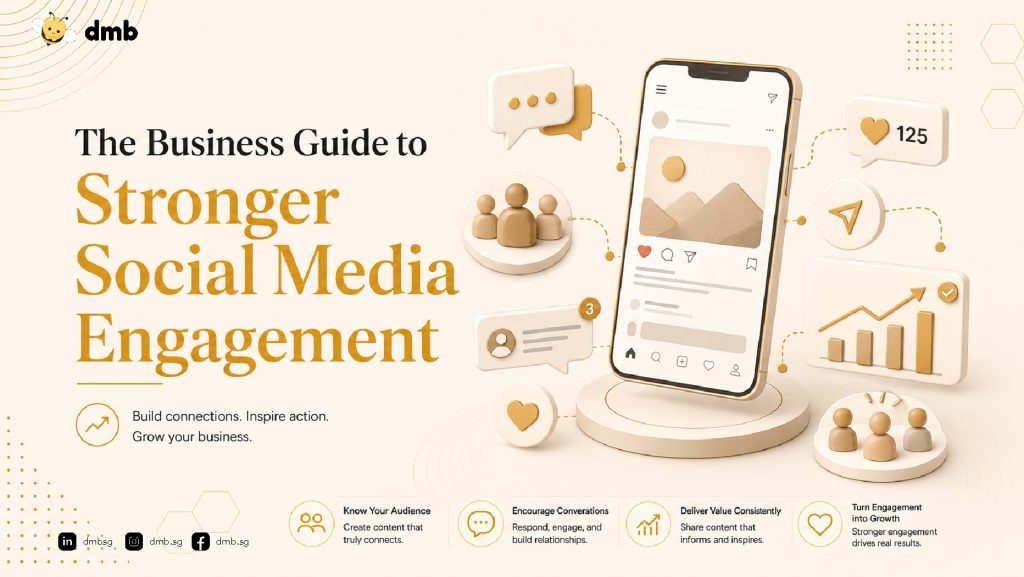
Social media engagement is often reduced to likes, comments, and follower growth. However, for businesses, meaningful engagement goes further than visible reactions.
It includes the moments when someone saves a useful post, shares it with a colleague, sends a direct message, visits a service page, replies to a Story, or remembers the brand when they are ready to buy.
That distinction matters.
A post can receive high reach but create little value if the audience scrolls past it without taking interest in the message. On the other hand, a post with fewer views may generate strong commercial outcomes if it starts relevant conversations with the right people.
Therefore, businesses should not aim to increase engagement simply for vanity metrics. Instead, they should focus on creating content and interactions that signal relevance, trust, and audience intent.
According to DataReportal’s Digital 2026: Singapore report, Singapore had 5.33 million active social media user identities in October 2025, equivalent to 90.6% of the population. This makes social platforms an important environment for brand discovery, customer research, and relationship-building. However, the same opportunity also means audiences see a large volume of content every day.
To stand out, brands need to offer more than frequent posting. They need to be useful, recognisable, and responsive.
This guide explains how to increase social media engagement in a way that supports stronger brand relationships, qualified traffic, and long-term business growth.
Why Meaningful Audience Interaction Matters More Than Vanity Metrics
Likes still have value. They can show that content has earned an initial positive response. However, they do not always reveal whether people found the post useful, credible, memorable, or commercially relevant.
For businesses, stronger engagement signals often include:
- Saves, which suggest the audience wants to revisit the content
- Shares, which indicate the message may be useful to others
- Comments that ask questions or contribute an opinion
- Direct messages that show purchase interest or request more information
- Profile visits from new audiences
- Link clicks to an article, service page, product page, or lead form
- Repeat engagement from the same community members
In other words, engagement should be evaluated through quality as well as quantity.
A marketing team should ask:
“Did this content create the response we wanted from the right audience?”
For example, an agency publishing a post about website conversion may not need thousands of likes. It may be more valuable to receive several thoughtful comments from founders, marketing leads, or business owners who want to understand why their website traffic is not converting.
That is meaningful engagement.
How to Increase Social Media Engagement With Audience-First Content
The fastest way to lose audience attention is to create content only around what the business wants to say.
People engage when content helps them understand a problem, make a decision, avoid a mistake, or feel seen. Therefore, strong social content should begin with audience needs rather than internal announcements.
A useful starting point is to identify the questions customers ask before they enquire, buy, or renew.
These may include:
- Why is our marketing not generating enough leads?
- How do we know whether our current strategy is working?
- What should we prioritise before spending more on advertising?
- Why does our website attract traffic but not enquiries?
- Which social media platform is worth focusing on?
- How can we improve customer trust online?
When businesses consistently answer these questions, their content becomes more useful and easier to engage with.
Build Content Around Specific Problems
Broad content usually creates broad responses. Specific content creates stronger relevance.
For example, instead of posting:
“Social media is important for business growth.”
Try a clearer angle:
“Your social posts may be getting views but still failing to create enquiries. Here are three signs your content is attracting attention without building intent.”
The second version gives the audience a reason to stop scrolling. It also frames the business as a helpful guide rather than a brand that only promotes itself.
Use a Simple Value Formula
Before publishing, review whether the post contains at least one of these elements:
- A practical lesson
- A useful opinion
- A clear framework
- A relatable challenge
- A real example
- A customer insight
- A surprising observation
- A next step the audience can take
If a post does not teach, clarify, inspire, entertain, or start a relevant conversation, it may not give people enough reason to engage.
Engagement-Driven Content Formats That Encourage Action
Different formats encourage different forms of engagement. Therefore, businesses should not rely on one type of post only.
A healthy content mix helps brands reach people with different preferences and levels of interest.
Short-Form Video for Reach and Discovery
Short videos can be effective when they communicate one clear point quickly.
Useful short-form formats include:
- “Three mistakes businesses make when…”
- “What most people misunderstand about…”
- “A quick way to improve…”
- “Before you spend more on ads, check this…”
- “Behind the scenes of how we solve…”
- “One marketing lesson from a recent project…”
The first few seconds matter. Start with the problem, insight, or tension rather than a long introduction.
For example:
“More followers will not fix a weak customer journey.”
This type of opening is direct, relevant, and easier to understand than a generic introduction.
Carousels for Saves and Shares
Carousels work well for educational content because they allow businesses to explain a process step by step.
They are especially useful for:
- Checklists
- How-to guides
- Frameworks
- Mistakes to avoid
- Before-and-after comparisons
- Industry myths
- Customer journey breakdowns
Keep each slide focused on one idea. Moreover, make the first slide clear enough to create curiosity and specific enough to attract the right audience.
Stories for Conversation and Relationship Building
Stories are useful for less formal engagement. They can help businesses create regular touchpoints without requiring every post to be highly produced.
Use Stories for:
- Polls and question stickers
- Behind-the-scenes content
- Quick opinions
- Team moments
- Event updates
- Customer questions
- Mini tutorials
- Reminders about a new article or offer
Unlike feed content, Stories can feel more immediate. As a result, they are often helpful for turning silent followers into active participants.
Proof-Led Posts for Trust
People are more likely to engage when they see evidence that a business understands its work.
Proof-led content may include:
- Customer testimonials
- Case-study snapshots
- Project lessons
- Team expertise
- Process breakdowns
- Results with clear context
- Screenshots of genuine feedback
- Before-and-after examples
However, avoid publishing results without explanation. A number alone may look impressive, but the context is what makes it credible.
Explain the starting challenge, the approach taken, what changed, and the lesson that applies to the audience.
Create Stronger Comments and Conversations
A common mistake is to treat comments as a passive metric. In reality, comments are an opportunity to build trust in public.
When someone asks a question, responds to a point, or shares an experience, the brand has a chance to show expertise and personality.
Instead of replying with a generic “Thanks for sharing,” try to move the conversation forward.
For example:
“That is a strong point. In many cases, the issue is not the amount of content but whether the message matches the audience’s stage of decision-making. Have you noticed this more with awareness posts or service-related posts?”
This reply does three things:
- It acknowledges the person.
- It adds useful context.
- It invites a deeper response.
As a result, the audience sees that the brand is present, thoughtful, and interested in conversation rather than just content distribution.
Use Questions With a Clear Purpose
Questions can increase engagement, but they should not feel forced.
Weak question:
“What do you think?”
Stronger question:
“Which is more challenging for your business right now: getting more traffic or turning existing traffic into qualified leads?”
The second question makes it easier for people to respond because it provides context and options.
Good questions often focus on:
- Audience pain points
- Industry shifts
- Decision-making challenges
- Customer preferences
- Common mistakes
- Practical trade-offs
Community Management: Turn Replies Into Brand Trust
Publishing content is only half of social media engagement. The other half is how a business responds.
Customers increasingly expect brands to provide helpful, personalised support through social channels. Sprout Social’s 2025 research found that personalised customer service was the top social-media priority consumers wanted from companies.
This does not mean every reply needs to become a sales conversation. Instead, it means businesses should make people feel heard.
A practical community-management system should include:
- Clear response-time targets
- A defined tone of voice
- Templates for recurring questions
- A process for handling complaints
- Escalation paths for technical or account issues
- Clear handover rules for high-intent enquiries
- A monthly review of recurring questions and feedback
In addition, customer questions can become valuable content ideas.
For instance, if several people ask about the difference between social media reach and engagement, turn that question into a carousel, short video, article, or FAQ post.
This creates a stronger feedback loop between the audience and the content strategy.
Improve Posting Consistency Without Posting for the Sake of It
Consistency is important, but constant posting is not always the answer.
If a team publishes too frequently without enough insight, content quality can fall. The audience may see more posts but feel less interested in engaging with them.
Instead, create a realistic publishing rhythm.
For many businesses, this could include:
- Two educational posts per week
- One proof-led or case-study post per week
- One human, cultural, or behind-the-scenes post per week
- Regular Story activity for interaction
- A monthly long-form article, webinar, report, or video to repurpose
This approach gives the brand a repeatable structure without making every post feel identical.
Additionally, repurpose strong ideas rather than constantly starting from zero.
A webinar can become:
- Several short videos
- A LinkedIn post
- An Instagram carousel
- A newsletter topic
- A blog article
- A set of Story questions
Repurposing allows the business to reinforce its expertise while adapting the message for different formats.
Measure Social Engagement That Supports Business Outcomes
A strong engagement strategy should be measured through more than total likes.
Track metrics based on the purpose of each content type.
| Content Objective | Useful Metrics |
| Awareness | Reach, impressions, video views, profile visits |
| Educational Value | Saves, shares, watch time, completion rate |
| Conversation | Comments, replies, direct messages, poll responses |
| Trust | Positive sentiment, testimonials, repeat interactions |
| Traffic | Link clicks, website sessions, article views |
| Lead Generation | Form submissions, consultation bookings, qualified enquiries |
One useful calculation is engagement rate by reach:
Engagement Rate by Reach = Total Engagements ÷ Reach × 100
Total engagements may include likes, comments, saves, shares, clicks, replies, or direct messages, depending on the platform and reporting method.
However, avoid comparing every post against one universal benchmark. A short video, carousel, Story, and long-form LinkedIn post often create different types of interaction.
Instead, compare:
- Similar formats against similar formats
- Current performance against previous performance
- Content themes against business objectives
- Reach-based engagement against traffic and lead quality
Use UTM parameters for links shared on social media so that Google Analytics can show which platform, campaign, and content asset generated traffic.
For example:
https://www.example.com/guide?utm_source=linkedin&utm_medium=organic_social&utm_campaign=engagement_growth
This helps businesses identify whether a high-performing post created only social reactions or meaningful website actions.
Build E-E-A-T Through Useful Social Content
Social media engagement grows faster when the audience trusts the source.
That is where Experience, Expertise, Authoritativeness, and Trustworthiness matter.
Show Experience
Share lessons from real projects, practical challenges, customer questions, and campaign outcomes. Specific insight is more credible than general advice.
Demonstrate Expertise
Use clear explanations from founders, specialists, and practitioners. Break down complex topics into language that helps people make better decisions.
Strengthen Authoritativeness
Support important claims with research, case studies, trustworthy industry sources, and transparent examples.
Protect Trustworthiness
Avoid exaggerated promises. Be honest about limitations, disclose partnerships where relevant, respond professionally to criticism, and verify important information before publishing.
Over time, this consistency helps audiences recognise the difference between content designed to fill a feed and content created by a business that genuinely understands the subject.
A Practical 30-Day Plan to Boost Social Interaction
Week 1: Audit What People Already Engage With
- Review your top 10 posts from the last three months
- Identify which topics earned saves, shares, and comments
- Check which posts drove profile visits or website clicks
- Review frequently asked questions from comments and direct messages
- List the three most relevant audience challenges
Week 2: Build a More Intentional Content Mix
- Create two educational posts
- Publish one proof-led post
- Produce one short video with a strong opening hook
- Prepare Stories with polls or questions
- Add clear but relevant calls to action
Week 3: Strengthen Community Interaction
- Respond to every relevant comment
- Ask follow-up questions where appropriate
- Use Story polls or Q&A stickers
- Turn one audience question into a new post
- Highlight a customer insight, review, or success story
Week 4: Measure and Improve
- Compare reach, saves, shares, comments, and direct messages
- Review social traffic using UTM-tagged links
- Identify the content theme with the strongest quality engagement
- Refine weak hooks or unclear calls to action
- Plan next month around audience response, not assumptions
Conclusion
Learning how to increase social media engagement is not about finding one viral formula.
It is about creating a repeatable system where useful content, clear brand positioning, active community management, and thoughtful measurement work together.
The strongest brands do not chase every trend or publish simply to stay visible. Instead, they help audiences solve problems, share credible perspectives, respond with care, and make the next step easy.
When people feel that a brand understands their challenges and consistently provides value, they are more likely to save, share, comment, click, and return.
That is the kind of engagement that supports real business growth.
Free Expert
Digital Marketing Consultation
Our expert digital marketing consultants offer you a no-risk marketing consultation that covers
Developing a tailored strategy to boost your leads and sales.
Uncovering the five key elements vital for digital marketing success.
See what your competitors are up to and learn how to beat them.