


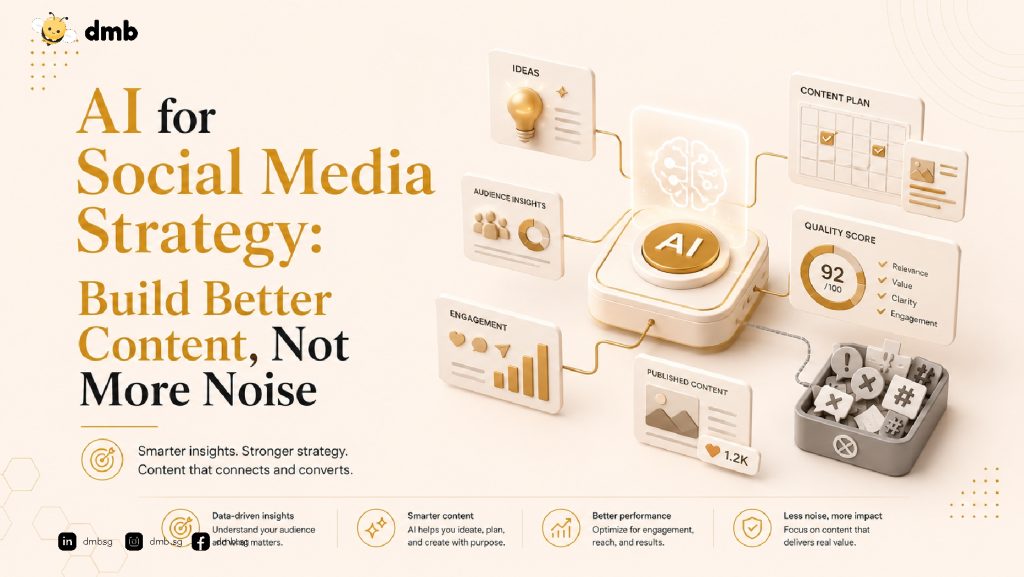
Social media teams are expected to do more than publish content.
They are expected to understand audience behaviour, monitor trends, respond to customers, create videos, analyse performance, report results, and keep the brand relevant across multiple platforms. For many businesses, especially those with lean marketing teams, that workload can become difficult to manage consistently.
This is where AI tools can help.
Used well, AI can reduce repetitive work, speed up research, organise ideas, summarise conversations, support content creation, and uncover patterns in social data. However, AI should not become a replacement for strategy, customer understanding, or human judgement.
The best use of AI is not to produce more posts simply because it can. Instead, it is to help a business create more relevant content, make faster decisions, and spend more time on the work that requires real expertise.
Recent research shows that AI adoption is now widespread across business functions, including marketing and sales. Yet many organisations are still experimenting rather than building AI into clear, measurable workflows. That creates an opportunity for businesses to move beyond random AI usage and develop a more structured approach.
This guide explains how AI tools for social media strategy can support planning, content creation, customer insight, reporting, and business growth without weakening brand authenticity.
Why AI Is Changing Social Media Marketing Workflows
Social media moves quickly.
A team may need to respond to a customer issue in the morning, publish a campaign update at noon, review performance data in the afternoon, and prepare next week’s content plan before the day ends. When these activities are handled manually, important insight can be missed.
AI can support this process by helping teams work with large amounts of information more efficiently.
For example, AI can help marketers:
- Summarise social listening data
- Identify recurring customer questions
- Generate content ideas from audience behaviour
- Repurpose long-form content into short-form posts
- Draft caption variations for different platforms
- Analyse campaign performance
- Detect changes in conversation volume
- Create reporting summaries for internal teams
- Organise content calendars
- Improve response workflows for customer enquiries
However, faster output does not automatically create better marketing.
A business can use AI to produce fifty captions in a few minutes, but those captions may still feel generic if they are not based on a clear audience insight, brand perspective, or commercial goal.
Therefore, AI should support the strategy rather than define it.
AI Tools for Social Media Strategy: Start With the Right Business Problem
Before choosing any AI tool, define the problem you are trying to solve.
This step is important because businesses often adopt tools based on hype rather than actual workflow needs. As a result, they end up paying for software that creates more dashboards, more content, or more complexity without improving outcomes.
A better question is:
“Which social media task is slowing our team down or limiting our ability to make better decisions?”
The answer may fall into one of several areas.
| Business Need | AI Use Case |
| Content ideas are inconsistent | Topic research, idea generation, content pillar support |
| The team spends too long writing captions | Caption drafts, tone variations, editing support |
| Audience feedback is difficult to analyse | Social listening summaries, sentiment themes, recurring questions |
| Reporting is too manual | Performance summaries, trend analysis, dashboard insights |
| The brand lacks visual consistency | AI-assisted design, template generation, on-brand visual concepts |
| Customer messages are increasing | Response suggestions, routing, FAQ classification |
| Content is published but not improving | Pattern detection, post-performance analysis, optimisation ideas |
The right tool depends on the problem.
For instance, a small business may benefit most from AI-assisted planning and caption drafting. A larger brand with high message volume may need AI-powered social listening and customer-care support. Meanwhile, a technology company may use AI to transform complex product information into clearer educational content.
AI-Powered Audience Research and Social Listening
One of the strongest uses of AI in social media is research.
Businesses often have valuable audience insight already available in comments, reviews, direct messages, support tickets, competitor conversations, forums, and social listening data. The challenge is turning that information into something useful.
AI can help identify patterns across large volumes of feedback.
For example, a team can use AI to analyse:
- Common customer questions
- Frequently mentioned frustrations
- Product requests
- Competitor complaints
- Sentiment around a campaign
- Industry topics gaining attention
- Emerging language or phrases used by the audience
- Reactions to a recent product launch
This can improve content strategy because it shifts the focus away from assumptions.
Instead of publishing generic advice about “business growth,” a company can identify that customers are repeatedly asking why social media traffic does not convert into enquiries. That insight can become a short video, carousel, article, webinar, or lead-generation guide.
Turn Conversations Into Content Opportunities
A practical workflow may look like this:
- Collect comments, messages, reviews, and customer questions.
- Group them by topic.
- Ask AI to identify repeated themes, objections, and language patterns.
- Validate the findings with a marketing or customer-facing team member.
- Turn the strongest themes into content pillars or campaign ideas.
- Monitor performance and refine the approach.
This process helps businesses create content that feels more relevant because it is connected to real audience concerns.
Content Planning and Idea Generation With AI
AI can reduce the pressure of constantly starting from a blank page.
For social media teams, idea generation is often one of the most time-consuming tasks. A content calendar may require dozens of topics each month, and not every idea needs to become a completely new campaign.
AI can help transform one strong idea into multiple useful formats.
For example, a single long-form article could become:
- A LinkedIn insight post
- An Instagram carousel
- A short video script
- A question for Stories
- A newsletter introduction
- A customer-facing FAQ
- A discussion prompt for a community group
This does not mean every piece of content should be copied and pasted across platforms. The core idea can remain consistent, while the delivery changes to match the platform.
Use AI to Strengthen Content Pillars
A good prompt should give AI enough context.
Instead of asking:
“Give me social media ideas.”
Try:
“Create 20 educational content ideas for a digital marketing agency targeting business owners. Focus on social media strategy, website conversion, marketing measurement, and lead quality. Use a practical and confident tone. Avoid generic beginner topics.”
The second prompt provides audience, business context, content themes, and tone guidance. As a result, the output is more likely to be useful.
Even then, the team should review each idea before publishing. AI can create options, but it cannot fully understand the company’s customer relationships, market position, brand history, or strategic priorities without human input.
AI-Assisted Copywriting Without Losing Brand Voice
Caption writing is one of the most common AI use cases for social media teams.
AI can help marketers create first drafts, rewrite complex language, generate multiple hooks, adjust tone, shorten copy, and create platform-specific variations.
For example, the same core message may need to become:
- A professional LinkedIn post
- A concise Instagram caption
- A short TikTok script
- A customer-friendly Facebook post
- A headline for a paid social campaign
This can save time. However, a first draft should never be the final draft by default.
A strong brand voice requires consistency, judgement, and experience.
Before publishing AI-assisted copy, review:
- Does the message sound like the brand?
- Is the claim accurate and supportable?
- Does the wording feel useful rather than overly promotional?
- Is the content specific to the audience?
- Are there any compliance, legal, or reputational risks?
- Does the call to action match the audience’s level of intent?
AI is especially useful for variation. It can produce several angles around the same theme, allowing the team to test different hooks while keeping the strategy consistent.
Creative Production and Visual Content Systems
Visual content is essential for social media, but consistent design can require significant time.
AI-enabled design platforms can help businesses generate concepts, adapt layouts, resize assets, remove background distractions, create visual variations, and develop on-brand templates more efficiently.
For example, AI-assisted design workflows can support:
- Social post concepts
- Carousel layouts
- Video cover ideas
- Visual mood boards
- Image cleanup
- Brand template development
- Basic animation ideas
- Content repurposing
- Text-to-image concepts for original campaigns
However, visual speed should not come at the expense of brand consistency.
Businesses should still define clear visual guidelines, including:
- Brand colours
- Typography
- Image direction
- Tone of photography
- Graphic hierarchy
- Logo use
- Illustration style
- Accessibility requirements
AI can generate visual options. The brand team should decide which options actually represent the business.
Social Scheduling, Optimisation, and Workflow Efficiency
AI can also support operational work that often consumes time but does not require deep creative judgement.
This may include:
- Drafting a monthly content calendar
- Recommending post variations
- Repurposing high-performing content
- Organising content themes
- Summarising campaign performance
- Identifying posting gaps
- Suggesting timely content opportunities
- Creating first-draft reporting summaries
For example, a social media management platform may use AI to help teams turn a trending topic into a draft post, generate caption options, or summarise social performance. Meanwhile, a general-purpose AI assistant can help analyse a spreadsheet of post-level data to identify themes behind high-performing content.
The most useful workflow is usually not fully automated.
Instead, it combines:
- AI for speed and pattern recognition
- Human review for context and quality
- Clear approval processes for brand safety
- Measurement to determine whether the workflow improves results
This balance prevents the business from producing large volumes of low-value content.
Analytics and Reporting: From Metrics to Decisions
Social media reporting often becomes a collection of numbers without a clear conclusion.
A team may report impressions, engagement rate, follower growth, and video views, but decision-makers still want to know what changed, why it changed, and what should happen next.
AI can help turn raw numbers into structured insights.
For example, AI can support questions such as:
- Which content themes generated the highest saves and shares?
- Which post formats drove the strongest website traffic?
- Did educational content outperform promotional content?
- Which audience questions appeared most frequently this month?
- What changed after a campaign launch?
- Which platforms contributed to qualified enquiries?
- What content should we test next month?
This becomes more valuable when social data is connected to business outcomes.
Use UTM parameters when sharing important links so that website analytics can identify which platform, campaign, and content asset drove traffic or conversions.
For example:
https://www.example.com/guide?utm_source=linkedin&utm_medium=organic_social&utm_campaign=ai_social_strategy
AI can help interpret the data, but the team still needs to define what success means. A campaign focused on awareness should not be judged by the same criteria as a campaign focused on consultation bookings.
Risks of Using AI for Social Media Content
AI can improve efficiency, but it also introduces risks.
The biggest mistake is assuming that generated content is automatically accurate, original, safe, or aligned with the brand.
Common risks include:
- Incorrect information or unsupported claims
- Generic messaging that weakens brand differentiation
- Repetitive captions and predictable content patterns
- Inconsistent tone of voice
- Misinterpretation of sensitive audience conversations
- Copyright or intellectual-property concerns
- Privacy risks when customer information is uploaded carelessly
- Inappropriate responses during customer-service situations
- Overreliance on automation without human approval
For this reason, businesses should create an AI governance checklist.
A Practical AI Approval Checklist
Before publishing AI-assisted content, confirm:
- Facts and figures have been verified.
- Claims are supported by evidence.
- Customer information has not been exposed.
- The tone matches the brand voice.
- The content is appropriate for the platform.
- The image, copy, and CTA have been reviewed by a human.
- Sensitive topics have an escalation process.
- The final post provides genuine value to the audience.
Human involvement is especially important when content involves finance, health, legal matters, customer complaints, crisis communication, or high-stakes business decisions.
Build E-E-A-T Into Your AI Social Media Workflow
AI should strengthen Experience, Expertise, Authoritativeness, and Trustworthiness, not dilute them.
Show Experience
Use AI to organise insights from real projects, customer feedback, and campaign data. Then add the practical lessons your team learned through actual work.
Demonstrate Expertise
Ask specialists, founders, and practitioners to review AI-generated drafts. Their judgement turns a general output into a credible point of view.
Strengthen Authoritativeness
Support claims with reliable research, verified performance data, case studies, and trusted industry sources. Do not let AI generate citations or statistics without checking them.
Protect Trustworthiness
Be transparent when appropriate, protect customer privacy, and ensure there is a human approval process before publishing. Trust is built through accuracy and consistency, not automation alone.
A Simple AI Workflow for Social Media Teams
A practical monthly workflow may look like this:
Week 1: Research and Insight Collection
- Gather customer questions, reviews, social comments, and competitor observations.
- Use AI to group recurring themes.
- Validate findings with the sales, customer-care, or product team.
Week 2: Planning and Content Development
- Turn the strongest themes into content ideas.
- Create a mix of educational, proof-led, human, and conversion-focused content.
- Use AI to produce first-draft outlines, hooks, captions, and platform variations.
Week 3: Production and Publishing
- Create visual assets using approved templates.
- Review all copy and claims before publication.
- Schedule posts and prepare community-response guidance.
Week 4: Measurement and Optimisation
- Review content performance by format, topic, and platform.
- Identify what generated quality engagement, traffic, or enquiries.
- Ask AI to summarise patterns, then use human judgement to decide what to test next.
Conclusion
AI tools for social media strategy can help businesses move faster, spot patterns earlier, and reduce repetitive work.
They can support research, planning, copywriting, visual production, scheduling, social listening, and reporting. However, the strongest results come when AI is used as a support system rather than an autopilot.
The goal is not to publish more content.
The goal is to create more relevant content, respond more intelligently to audience needs, and make decisions based on clearer insight.
When AI is combined with strong strategy, human expertise, brand governance, and meaningful measurement, it can help social media teams become more efficient without becoming less authentic.
Free Expert
Digital Marketing Consultation
Our expert digital marketing consultants offer you a no-risk marketing consultation that covers
Developing a tailored strategy to boost your leads and sales.
Uncovering the five key elements vital for digital marketing success.
See what your competitors are up to and learn how to beat them.