


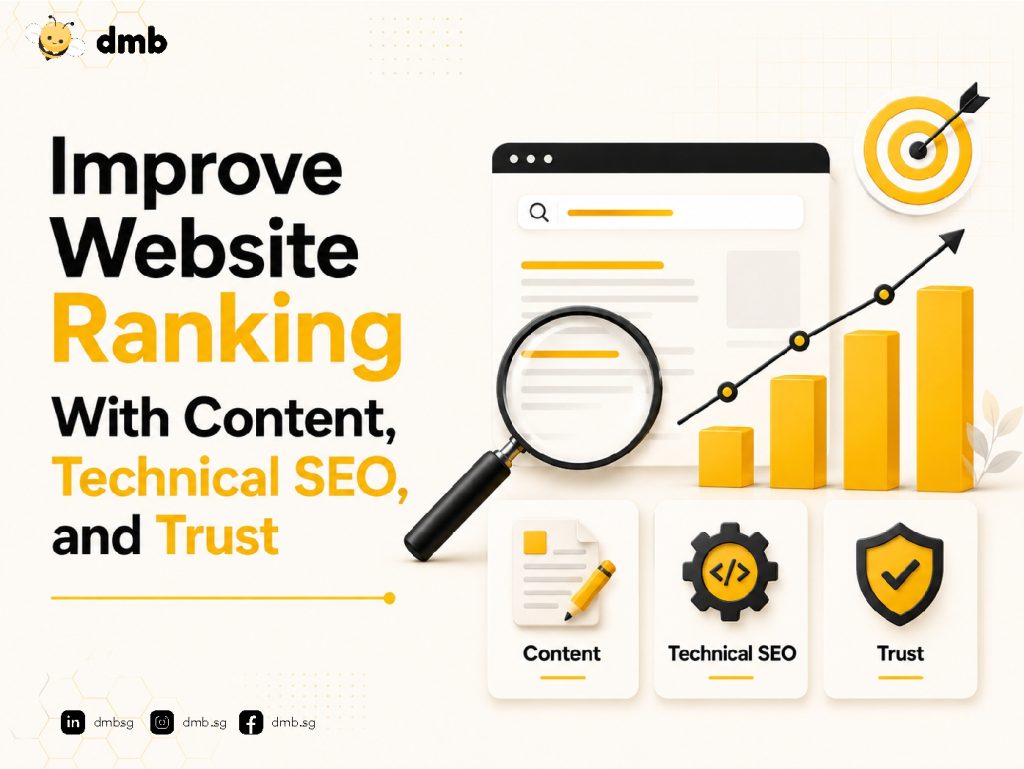
Improving a website’s ranking is not about finding one hidden trick, adding keywords repeatedly, or publishing large volumes of content without a clear purpose.
A stronger search position is usually the result of several connected elements working together: relevant content, healthy technical foundations, clear website structure, trustworthy information, and a user experience that helps visitors take the next step.
For businesses, site ranking matters because search engines often become part of the customer decision-making journey. Before someone contacts a provider, books a consultation, or purchases a product, they may search for solutions, compare options, review content, and assess whether a business appears credible.
In a highly digital market, this opportunity is significant. Singapore had 5.78 million internet users at the end of 2025, equivalent to 98.4% internet penetration. This means customers can research brands, services, and alternatives online before they ever speak to a sales representative.
However, stronger rankings should not be the only objective.
A page that ranks well but attracts the wrong audience will not create meaningful business value. Likewise, a high-traffic article without a relevant next step may generate visibility without supporting leads or revenue.
Therefore, the goal is not simply to rank higher. The goal is to become more useful, more discoverable, and more credible for the people most likely to need your offer.
This guide explains a practical strategy to improve site ranking while building long-term organic growth.
Why Better Search Visibility Begins With Business Relevance
Search engines aim to provide useful answers to people’s questions. Therefore, businesses should begin their SEO strategy by understanding what potential customers are searching for and why they are searching.
A keyword may look attractive because it has high search volume. However, it may not be valuable if it does not match the business offer or the audience’s level of intent.
For example, a digital marketing agency may receive traffic from a broad keyword such as “marketing tips.” Yet that audience may only be looking for free ideas. Meanwhile, someone searching “SEO strategy for business” may be closer to evaluating professional support.
That is why business relevance matters.
Before creating or optimising a page, ask:
- Does this topic connect naturally to our product or service?
- Is the searcher looking for information, comparison, or action?
- Can we offer a more useful answer than existing pages?
- Does this page lead naturally to another relevant business step?
- Is the content aligned with our expertise?
When SEO is connected to real customer problems, traffic quality usually improves.
Strategy to Improve Site Ranking: Start With Search Intent
Search intent describes what a person expects to find after entering a query.
Understanding intent helps businesses choose the right format, angle, and call to action for each page.
Informational Intent
Informational searches happen when users want to learn something.
Examples include:
- What is technical SEO?
- How does keyword research work?
- Why is website speed important?
- How to improve organic traffic?
The best content for informational intent is usually educational:
- Blog articles
- Guides
- Checklists
- Explainer videos
- Glossaries
- Frameworks
- Tutorials
Commercial Investigation Intent
Commercial searches happen when users are comparing options before making a decision.
Examples include:
- Best SEO agency for small business
- SEO tools for marketing teams
- SEO services pricing
- SEO audit vs technical SEO audit
This stage may require comparison pages, case studies, service breakdowns, reviews, and clear explanations of what makes one approach different from another.
Transactional Intent
Transactional searches happen when someone is ready to take action.
Examples include:
- SEO consultant near me
- Book SEO audit
- SEO agency Singapore
- Website optimisation services
These users need clear service pages, concise value propositions, proof, transparent contact options, and simple calls to action.
A strong website does not rely on only one intent type. Instead, it creates content across the customer journey so that people can discover, research, trust, and eventually contact the business.
Build a Keyword Map Around Customer Problems
Keyword research should not begin with a spreadsheet full of search volume. Instead, begin with the questions, frustrations, and goals your customers already have.
For example, a business looking to improve its search performance may ask:
- Why is my website not ranking?
- How can I improve Google visibility?
- What SEO issues are limiting performance?
- Why are competitors appearing above my website?
- How do I improve website traffic without increasing ad spend?
- What should I fix first: content, speed, backlinks, or technical errors?
- How can I measure whether SEO is working?
These questions can be grouped into topic clusters.
| Main Topic | Supporting Keyword Themes |
| SEO Strategy | SEO planning, organic growth, search visibility |
| Technical SEO | crawlability, indexing, site speed, mobile usability |
| Content Optimisation | search intent, on-page SEO, keyword relevance |
| Website Authority | backlinks, trust signals, digital PR |
| SEO Measurement | Search Console, rankings, clicks, organic conversions |
| Local Search | local SEO, Google Business Profile, location pages |
This structure helps businesses avoid random content production.
Instead of publishing unrelated blog posts, each article supports a larger theme and guides users toward the next logical page.
Fix Technical Barriers Before Scaling Content
Strong content cannot perform at its full potential if search engines struggle to crawl, index, or understand the website.
Technical SEO does not always require a complete rebuild. However, businesses should regularly review the foundations that affect accessibility and user experience.
Essential Technical SEO Checks
- Important pages can be crawled and indexed
- XML sitemap is submitted through Google Search Console
- Robots.txt does not block critical pages
- Internal links work correctly
- Broken pages and redirect chains are reviewed
- Duplicate pages have appropriate canonical signals
- URLs are descriptive and readable
- Mobile pages contain important desktop content
- HTTPS is active across the website
- Core Web Vitals are monitored
- Large images are compressed appropriately
- Pop-ups do not block the main content
- Navigation is easy for users and search engines to follow
Technical work should be prioritised based on impact.
For example, fixing a page that is accidentally blocked from search engines will usually matter more than adjusting a minor visual element. Similarly, resolving broken internal links on key service pages may be more valuable than chasing an ideal performance score in every audit tool.
The objective is not technical perfection. It is removing the obstacles that prevent good content from being found and used.
Improve On-Page SEO Through Clarity, Not Keyword Stuffing
On-page SEO helps search engines and users understand what each page is about.
However, optimisation should not make content feel unnatural. Repeating the same keyword too often can reduce readability and make the page feel less trustworthy.
A better approach is to create topical clarity.
Key Elements of Strong On-Page Optimisation
Use a Clear Page Title
The page title should describe the content accurately, include the core topic naturally, and give users a reason to click.
For example:
Strategy to Improve Site Ranking: A Practical SEO Framework
Create Helpful Headings
Headings should organise the page into clear sections.
Instead of using generic headings such as “More Information,” use specific headings such as:
- Improve Technical Website Health
- Build Content Around Search Intent
- Strengthen Internal Linking Structure
- Measure Organic Search Performance
This helps users scan the page quickly while reinforcing topic relevance.
Write for Questions, Not Just Keywords
Users do not search only for individual words. They search because they have a problem to solve.
Therefore, content should answer questions directly and clearly.
For example, instead of only targeting “site ranking strategy,” explain:
- Why rankings may be declining
- Which pages should be prioritised
- How to identify technical issues
- What content improvements create stronger relevance
- How to measure progress over time
Add Relevant Internal Links
Internal links help users discover related content and help search engines understand how pages connect.
For example, an article about improving site ranking could link naturally to:
- A technical SEO audit guide
- A keyword research article
- A local SEO service page
- A content strategy resource
- A digital marketing consultation page
Use descriptive anchor text rather than generic phrases such as “click here” or “read more.”
Build Helpful Content That Earns Trust
Search visibility is increasingly connected to quality.
A business cannot rely on thin articles, copied summaries, or generic AI-generated pages and expect sustainable performance. Content needs to demonstrate usefulness, credibility, and a clear understanding of the audience.
This is where E-E-A-T becomes important.
Show Experience
Include practical observations, project lessons, customer challenges, and real examples.
For instance, instead of saying:
“Website speed affects rankings.”
A stronger statement may be:
“When service pages underperform, the issue is often not speed alone. It is usually a combination of slow loading, unclear positioning, weak calls to action, and poor mobile usability.”
This feels more helpful because it explains the broader business context.
Demonstrate Expertise
Use subject-matter experts, marketers, strategists, developers, or founders to contribute to and review content.
Expertise becomes more visible when the content explains not only what to do, but why it matters.
Build Authoritativeness
Support important claims with reliable research, industry sources, transparent examples, and relevant case studies.
Authoritative content does not need to sound overly formal. It simply needs to be accurate, useful, and supported by clear reasoning.
Protect Trustworthiness
Avoid unrealistic promises such as “rank number one in seven days.”
No ethical SEO professional can guarantee a specific position because rankings depend on competition, technical health, relevance, user signals, search changes, and many other factors.
Trust grows when businesses explain the process honestly and set realistic expectations.
Strengthen Website Architecture and Internal Linking
A website should guide users from broad educational topics to deeper resources, commercial pages, and conversion opportunities.
This is often where content clusters become valuable.
A content cluster includes one main pillar page supported by several related pages.
For example:
Pillar Page
Strategy to Improve Site Ranking
Supporting Pages
- Technical SEO Issues That Reduce Website Visibility
- How to Choose Keywords With Commercial Value
- Internal Linking Best Practices for SEO
- How to Optimise Service Pages for Search Intent
- SEO Metrics That Matter for Business Owners
- Common Website Ranking Mistakes to Avoid
Each article should link naturally to other relevant pages.
This helps users continue their research instead of leaving after reading one article. In addition, it creates a clearer site structure that supports search engine understanding.
Every important page should have at least one relevant internal link pointing to it. Otherwise, that page may be difficult for both users and search engines to discover.
Earn Authority Beyond Your Own Website
Content quality and technical health are important, but external trust signals also matter.
When credible websites, publications, partners, customers, or industry communities mention a business, it can strengthen visibility and reputation.
However, authority should be earned rather than manufactured.
Avoid buying low-quality backlinks or participating in link schemes. These tactics may create short-term movement, but they can introduce long-term risk.
Instead, focus on activities that create genuine reasons for others to reference your business:
- Publish original research or useful data
- Share expert commentary on industry topics
- Create tools, templates, or calculators
- Develop detailed guides worth referencing
- Build partnerships with credible organisations
- Earn media mentions through useful insights
- Publish customer success stories with permission
- Contribute practical expertise to relevant communities
The best links are usually a by-product of content that people genuinely find valuable.
Use Search Console to Identify Ranking Opportunities
SEO reporting should not focus only on position changes.
Rankings can move frequently, especially for competitive keywords. A better approach is to evaluate whether the website is becoming more visible, attracting more qualified traffic, and creating stronger business outcomes.
Google Search Console can help businesses review:
- Search queries that generate impressions
- Pages that receive clicks
- Average positions
- Click-through rates
- Countries and devices
- Indexing issues
- Core Web Vitals
- Crawl-related concerns
Practical Opportunities to Look For
| Performance Signal | Possible Action |
| High impressions, low clicks | Improve title tag and meta description |
| Ranking between positions 8–20 | Expand content, add internal links, improve relevance |
| High traffic, low conversion | Strengthen CTA, messaging, and landing-page experience |
| Declining clicks | Review search intent, competitors, freshness, and technical issues |
| Low impressions for service pages | Improve targeting and build supporting content |
| Important pages not indexed | Check crawlability, sitemap, robots, and canonical tags |
Measurement should lead to decisions.
For example, a page receiving many impressions but few clicks may not need more backlinks. It may simply need a clearer title that better matches the user’s search intent.
A 90-Day Roadmap for Better Search Rankings
Days 1–30: Audit and Prioritise
- Review Google Search Console and analytics data
- Identify pages with declining clicks or impressions
- Check index coverage and technical issues
- Audit key service pages
- Build a keyword map around customer intent
- Identify content gaps against competitors
- Set realistic growth targets
Days 31–60: Improve Core Pages and Content Structure
- Optimise page titles, headings, and meta descriptions
- Improve weak service pages
- Publish one comprehensive pillar page
- Create supporting articles around related topics
- Add contextual internal links
- Refresh outdated pages
- Improve mobile usability and page experience
Days 61–90: Measure, Refine, and Expand
- Review changes in impressions, clicks, and CTR
- Improve pages ranking on the second page
- Add more proof, examples, and expert input
- Strengthen links between related pages
- Optimise calls to action on high-traffic pages
- Identify new content opportunities from Search Console queries
- Create a recurring monthly SEO review process
SEO improvement is rarely immediate. However, businesses that consistently improve relevance, usability, authority, and measurement are more likely to create sustainable gains over time.
Rankings Improve When the Website Becomes More Useful
A strategy to improve site ranking should not focus on shortcuts.
It should focus on making the website easier to understand, easier to navigate, more relevant to customer needs, and more trustworthy than competing alternatives.
The strongest SEO strategies combine technical health, helpful content, search intent, internal linking, authority signals, and regular performance review.
When these elements work together, rankings become a result of better business communication rather than the only goal.
That is what makes SEO sustainable.
Free Expert
Digital Marketing Consultation
Our expert digital marketing consultants offer you a no-risk marketing consultation that covers
Developing a tailored strategy to boost your leads and sales.
Uncovering the five key elements vital for digital marketing success.
See what your competitors are up to and learn how to beat them.