


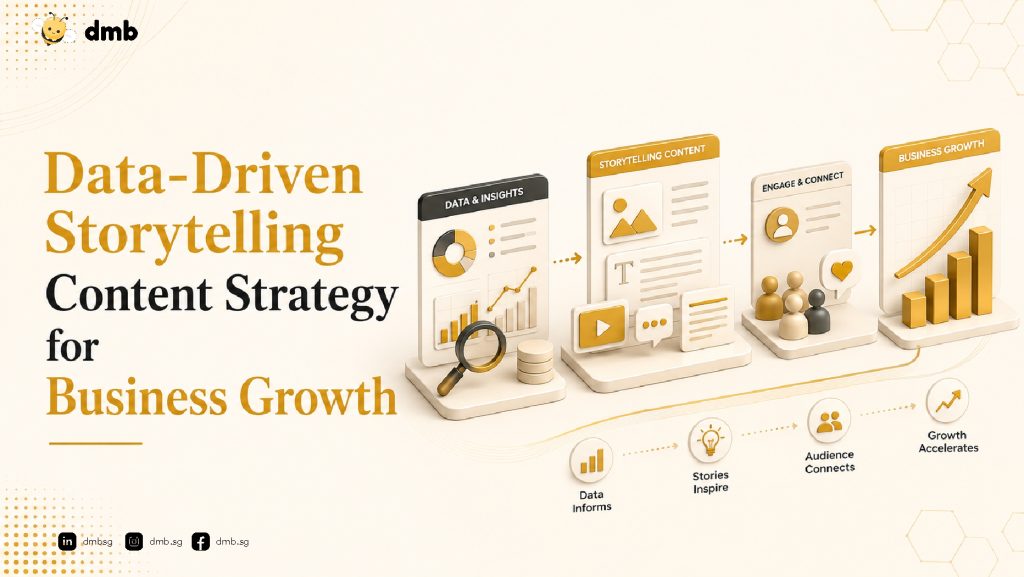
Modern businesses have more data than ever. Website analytics, Google Ads reports, CRM records, social media insights, search trends, customer reviews, sales calls, email performance, and campaign dashboards can all reveal what customers are doing. However, having data is not the same as understanding customers. More importantly, having data is not the same as communicating value.
This is where data-driven storytelling content becomes powerful.
Data driven storytelling content is the practice of turning data, insights, and evidence into clear, meaningful narratives that help audiences understand a problem, believe a message, and take action. It is not simply about adding statistics into an article. It is also not about creating charts that look impressive but say very little. Instead, it connects facts with context, emotion, customer pain points, and business relevance.
For businesses, this matters because customers are becoming more selective. They do not want generic marketing claims. They want proof. They want clarity. They want to know why a service matters, what problem it solves, and whether a business truly understands their situation. In digital marketing, this is especially important because potential customers often compare several providers before submitting a form, booking a consultation, or responding to an ad.
A business may say, “We help you grow online.” But a stronger data-driven story would say, “Many businesses generate traffic but lose potential leads because their landing pages do not match search intent. By analysing ad performance, conversion rate, and customer behaviour, we can identify where the journey breaks and improve the path from click to enquiry.”
The second message feels more credible because it explains the problem, uses insight, and connects the data to a business outcome.
In a highly digital market, data-driven storytelling content can help brands stand out across SEO, Google Ads, landing pages, case studies, social media, sales decks, and email campaigns. It helps businesses move beyond “we are good” and toward “here is what we know, why it matters, and how it helps you make a better decision.”
What is Data Driven Storytelling Content?
Data driven storytelling content is content that uses data as the foundation for a clear and persuasive story. It combines three elements: data, narrative, and audience relevance.
Data provides evidence. Narrative provides structure. Audience relevance makes the message useful.
Without data, storytelling can become too vague. Without storytelling, data can feel cold and confusing. Without audience relevance, both data and storytelling can fail to connect with the people you want to reach.
A Simple Definition
Data-driven storytelling content is a content approach that transforms raw information into a meaningful story that helps readers understand what is happening, why it matters, and what they should do next.
For example, instead of publishing a generic article about “why Google Ads matters,” a business can create content that explains:
- Which search behaviours show buyer intent
- Why cost per click does not tell the full story
- How landing page experience affects conversion
- What campaign data reveals about customer pain points
- Why certain offers perform better than others
- How data can guide budget allocation
This creates a more useful and trustworthy content experience.
How It Differs From Regular Content
Regular content often explains a topic. Data-driven storytelling content explains a topic with evidence, context, and direction.
Regular Content Example: “Google Ads can help businesses get more leads.”
Data-Driven Storytelling Example
“Google Ads can help businesses capture high-intent demand, but traffic alone is not enough. If the landing page does not answer the customer’s main concern, the campaign may generate clicks without enough enquiries. By reviewing search terms, conversion paths, and lead quality, businesses can identify which messages attract serious prospects and which ones only create wasted spend.”
The difference is depth. The second version helps the reader understand how the issue works in real business conditions.
Why Data-Driven Storytelling Content Matters for Businesses
Data-driven storytelling content matters because it helps businesses communicate with more authority. In digital marketing, attention is easy to lose. People scroll quickly, compare options, and ignore claims that sound too generic.
When content is supported by data and shaped into a clear story, it becomes easier for the audience to trust.
It Builds Credibility
Customers are more likely to trust a business that can explain its thinking. If your content shows that you understand customer behaviour, market trends, campaign performance, and business outcomes, your brand appears more credible.
For example, a digital marketing agency that explains how search intent affects lead quality sounds more experienced than one that only says, “We run effective ads.”
It Makes Complex Topics Easier to Understand
Digital marketing can be complex. Many business owners do not want to decode dashboards, attribution models, keyword reports, or traffic patterns. They want to know what the numbers mean for growth.
Data-driven storytelling simplifies complexity by turning information into a logical flow.
A good story can explain:
- What the data shows
- Why the trend matters
- What problem it reveals
- What action should be taken
- How the result can be measured
It Helps Content Support Sales Conversations
For middle-of-funnel audiences, content needs to do more than educate. It should help potential customers evaluate solutions and move closer to a decision.
Data-driven storytelling content can support sales by answering questions such as:
- Why is my website getting traffic but not leads?
- Why is my Google Ads cost increasing?
- Why are competitors appearing more often in search?
- Why do some campaigns generate poor-quality enquiries?
- How do I know whether paid media is working?
- What should I fix before increasing ad spend?
When content answers these questions clearly, it becomes a bridge between awareness and enquiry.
It Improves Paid Media Performance
Paid media does not work only because of targeting or bidding. It also depends on message quality. If your ads and landing pages are based on real customer insights, they are more likely to match what the audience cares about.
Data-driven storytelling can improve paid media by helping businesses create:
- Better ad angles
- Stronger landing page copy
- More relevant offers
- More convincing case studies
- Clearer audience segmentation
- Better remarketing messages
- More useful lead magnets
- Stronger consultation hooks
For example, instead of running a generic ad that says “Get More Leads,” a business can use insight-based messaging such as “Find out where your Google Ads budget is leaking before increasing spend.” This message is more specific because it speaks to a real business concern.
Data-Driven Storytelling Content and the Customer Journey
To use data-driven storytelling effectively, businesses need to understand where the audience is in the customer journey.
Since this topic is MoFu, or middle-of-funnel, the audience is not completely new. They may already understand the basic idea of digital marketing or content strategy. However, they are still evaluating whether this approach is relevant to their business.
Awareness Stage
At the awareness stage, people are trying to understand a problem.
Content examples:
- “Why your website traffic is not converting”
- “What Google Ads data can reveal about customer intent”
- “Why content without strategy fails to generate leads”
The goal is to explain the problem clearly.
Consideration Stage
At the consideration stage, people are comparing solutions.
Content examples:
- “Data-driven storytelling content vs traditional content marketing”
- “How insight-led content improves Google Ads landing pages”
- “How to use analytics to improve content strategy”
The goal is to show why your approach is more useful.
Decision Stage
At the decision stage, people want proof and confidence.
Content examples:
- Case studies
- Audit reports
- Before-and-after landing page analysis
- Campaign performance breakdowns
- Client success stories
- Consultation pages
The goal is to make the next step feel safe and valuable.
The Core Elements of Data-Driven Storytelling Content
Strong data-driven storytelling content usually includes five elements.
1. A Clear Business Question
Every good data story starts with a question. Without a question, data becomes directionless.
Examples:
- Why are leads decreasing?
- Which channel brings the best customers?
- Why is organic traffic dropping?
- Which landing page converts better?
- What customer segment has the highest value?
- Which message creates stronger engagement?
- Why is cost per lead increasing?
The question gives the story a purpose.
2. Relevant Data
Not all data is useful. The right data depends on the question.
Useful data sources may include:
- Google Analytics 4
- Google Search Console
- Google Ads reports
- CRM data
- Sales call notes
- Customer surveys
- Heatmaps
- Email marketing reports
- Social media analytics
- Competitor research
- Keyword research
- Customer reviews
However, data should not be added only to look impressive. Each data point should support the story.
3. Human Context
Data tells you what happened. Human context helps explain why it matters.
For example, if a landing page has a high bounce rate, the data alone does not explain everything. The real issue may be that the page does not match the ad promise, the content is too generic, the offer is unclear, or the form feels too demanding.
This is why data-driven storytelling needs both analytics and marketing judgement.
4. A Narrative Structure
A strong data story should have a flow.
A simple structure is:
- Problem
- Evidence
- Insight
- Implication
- Action
For example:
- Problem: Leads are decreasing.
- Evidence: Paid traffic is stable, but landing page conversion rate dropped.
- Insight: Users are clicking but not finding enough proof or relevance.
- Implication: Increasing ad spend may waste budget.
- Action: Improve landing page messaging, add trust signals, and test a clearer offer.
This structure makes the content easier to follow.
5. A Clear Next Step
Data-driven storytelling should guide action. The reader should not finish the content feeling informed but unsure what to do.
Depending on the page, the next step could be:
- Download a report
- Book a consultation
- Request a Google Ads audit
- Read a case study
- Compare service options
- Subscribe to insights
- Contact the team
- Review a checklist
For MoFu content, the CTA should feel helpful rather than aggressive.
How to Create Data-Driven Storytelling Content
Building this type of content requires a repeatable process.
1. Define the Audience and Decision Stage
Before looking at data, define who the content is for.
Ask:
- Is the audience a business owner, marketing manager, founder, or sales leader?
- Are they trying to understand a problem or choose a provider?
- What decision are they trying to make?
- What would make them trust the content?
- What business outcome do they care about?
For example, a business owner may not care about every technical metric in Google Ads. They may care about lead quality, cost, follow-up, and revenue. Therefore, the story should translate metrics into business meaning.
2. Choose One Main Insight
A common mistake is trying to include too many insights in one piece of content. This makes the story messy.
Choose one main message.
Examples:
- “Traffic does not guarantee leads.”
- “Better landing pages can improve paid media efficiency.”
- “Search intent matters more than keyword volume.”
- “Customer data can improve remarketing strategy.”
- “Content performs better when it answers real sales objections.”
Once the main insight is clear, every section should support it.
3. Collect Supporting Data
Use data that supports the story.
First-Party Data
This is data your business owns, such as website analytics, CRM records, campaign reports, and customer enquiries.
Third-Party Data
This includes industry research, market studies, platform reports, and credible external sources.
Qualitative Data
This includes customer interviews, reviews, comments, sales objections, and support conversations.
A strong content piece may combine all three.
4. Turn Data Into a Narrative
Do not simply list numbers. Explain what the numbers mean.
Weak example:
“Our conversion rate increased from 2% to 4%.”
Stronger example:
“After aligning the landing page headline with the highest-intent search queries, conversion rate increased from 2% to 4%. This suggests that users were not only looking for the service, but also needed clearer confirmation that the page matched their intent.”
The second version gives interpretation.
5. Add Visual or Structural Clarity
Data-driven storytelling does not always require complex charts. Sometimes a simple table, callout, comparison, or step-by-step breakdown is enough.
Useful formats include:
- Before-and-after comparison
- Problem-solution-action table
- Funnel breakdown
- Campaign timeline
- Customer journey map
- Insight callout
- Case study snapshot
- Simple chart
- FAQ
- Checklist
The goal is clarity, not decoration.
6. Connect the Story to a Business Outcome
Every data story should eventually answer: so what?
For example:
- If cost per lead is increasing, what should the business change?
- If organic traffic is dropping, how should the business respond?
- If users leave the landing page quickly, what does it mean for ad spend?
- If a content topic generates leads, how should the business scale it?
This is where content becomes strategic.
Data-Driven Storytelling Content for Google Ads
Google Ads can benefit greatly from data-driven storytelling because paid media performance depends on relevance, intent, and trust.
Better Search Ads
Search ads have limited space, so the message must be sharp. Data can reveal which pain points, keywords, and offers matter most.
For example, search term data may show that users are not only looking for “Google Ads agency” but also searching for “reduce cost per lead,” “improve lead quality,” or “Google Ads audit.”
That insight can guide ad copy.
Better Landing Pages
Landing pages should not be built around assumptions. They should be built around customer intent.
Data-driven landing pages may include:
- Search intent-based headlines
- Specific pain points
- Proof points
- Case study snippets
- Clear service process
- Comparison sections
- Objection-handling FAQs
- Trust signals
- Strong CTAs
Instead of a generic landing page, the business creates a page that answers what users are already thinking.
Better Remarketing
Remarketing should not repeat the same message to everyone. Data can help segment audiences based on behaviour.
For example:
- Blog readers may need educational content
- Pricing page visitors may need proof
- Returning visitors may need a consultation CTA
- Past leads may need a case study
- Existing customers may need an upsell or retention message
This makes paid media feel more relevant.
Better Customer Match Strategy
Google Ads Customer Match allows businesses to use customer data to reach and re-engage customers across Google channels such as Search, Shopping, Gmail, YouTube, and Display. For data-driven storytelling, this means customer segments can receive messages based on their relationship with the business.
For example:
- Existing customers can receive upgrade content
- Past leads can receive case studies
- High-value customers can receive premium service offers
- Inactive customers can receive re-engagement content
The story becomes more personalised because the data helps identify where the customer is in the relationship.
Examples of Data-Driven Storytelling Content
1. The Landing Page Audit Story
A business runs Google Ads but gets poor lead quality.
Data
The campaign has high clicks, but low conversion rate and weak lead quality.
Insight
The ad attracts interest, but the landing page does not qualify the audience clearly.
Story Angle
“Why your Google Ads traffic is not turning into qualified leads.”
This content can explain how search intent, page messaging, proof, and form design affect campaign quality.
2. The SEO Traffic Story
A website receives organic traffic but few enquiries.
Data
Search Console shows high impressions, GA4 shows low engagement, and CRM shows few qualified leads.
Insight
The content attracts early-stage readers but does not guide them toward the next step.
Story Angle
“How to turn informational SEO traffic into business enquiries.”
This content can bridge SEO and conversion strategy.
3. The Customer Journey Story
A business has multiple marketing channels but unclear attribution.
Data
Paid ads, organic search, social media, and direct traffic all contribute to conversions.
Insight
Customers do not convert from one touchpoint. They move through multiple interactions before enquiring.
Story Angle
“Why your marketing funnel needs a full customer journey view.”
This helps the business explain why full-funnel marketing matters.
Common Mistakes in Data-Driven Storytelling Content
1. Using Data Without a Point
A statistic is not automatically useful. It needs interpretation. If the reader does not know why the data matters, the content fails.
2. Making the Story Too Technical
Business audiences do not always need every technical detail. They need enough detail to trust the conclusion and understand the action.
3. Cherry-Picking Data
Only showing positive data can damage credibility. Strong data storytelling is honest. It explains limitations, assumptions, and context.
4. Ignoring the Customer’s Real Problem
Content should not be built only around what the business wants to say. It should be built around what the customer needs to understand.
5. Ending Without a Next Step
If the content explains a problem but does not guide action, it may educate the reader without moving them closer to conversion.
How to Measure Data-Driven Storytelling Content
To measure this type of content, businesses should track both engagement and business outcomes.
Content Performance Metrics
- Organic traffic
- Average engagement time
- Scroll depth
- Internal link clicks
- Returning users
- Newsletter sign-ups
- Download rate
- Content-assisted conversions
Paid Media Metrics
- Click-through rate
- Landing page conversion rate
- Cost per lead
- Lead quality
- Retargeting engagement
- Customer Match performance
- Cost per qualified lead
Business Metrics
- Enquiry quality
- Sales conversion rate
- Customer acquisition cost
- Customer lifetime value
- Consultation bookings
- Revenue influenced by content
- Repeat enquiries
- Referral opportunities
For MoFu content, assisted conversions are especially important. A reader may not convert immediately after reading an article, but the content can still influence the decision later.
E-E-A-T in Data-Driven Storytelling Content
E-E-A-T stands for Experience, Expertise, Authoritativeness, and Trustworthiness. For content that discusses marketing, data, and business growth, E-E-A-T is essential because readers are making real decisions based on the information.
To strengthen E-E-A-T, include:
- Clear author or company expertise
- Real examples from marketing practice
- Transparent methodology
- Reliable external references
- First-party insights where possible
- Honest limitations
- Case studies
- Practical frameworks
- Clear next steps
- Updated information
A strong data-driven storytelling article should not sound like a generic explanation. It should show that the writer understands how marketing works in real situations.
For example, instead of saying “data improves marketing,” explain how search term reports can reveal customer intent, how CRM data can show lead quality, and how landing page behaviour can expose friction in the conversion journey.
That level of explanation builds trust.
When Should a Business Use Data-Driven Storytelling Content?
A business should use data-driven storytelling content when it wants to educate, persuade, and guide prospects toward a more informed decision.
It is especially useful for:
- Google Ads agencies
- Digital marketing agencies
- B2B service providers
- SaaS companies
- Financial service providers
- Professional service firms
- Ecommerce brands
- Education providers
- Healthcare and wellness brands
- Real estate and property businesses
It is also useful when the buying decision requires trust. If customers need to compare providers, understand value, or justify budget internally, data-driven storytelling content can help reduce hesitation.
Conclusion
Data-driven storytelling content is one of the most effective ways to turn information into trust. It helps businesses move beyond generic claims and create content that is supported by evidence, shaped by narrative, and connected to customer needs.
In digital marketing, this matters because customers are not only looking for services. They are looking for clarity. They want to understand what is happening, why it matters, and which business can help them make better decisions.
For businesses that use Google Ads, SEO, landing pages, and content marketing, data-driven storytelling can improve both communication and performance. It can help create better ad messages, stronger landing pages, more persuasive case studies, and more relevant remarketing campaigns.
However, the goal is not to overwhelm people with numbers. The goal is to make data useful. A good data story simplifies complexity, explains meaning, and points toward action.
In the end, the businesses that win are not always the ones with the most data. They are the ones that know how to turn data into insight, insight into story, and story into action.
Free Expert
Digital Marketing Consultation
Our expert digital marketing consultants offer you a no-risk marketing consultation that covers
Developing a tailored strategy to boost your leads and sales.
Uncovering the five key elements vital for digital marketing success.
See what your competitors are up to and learn how to beat them.