


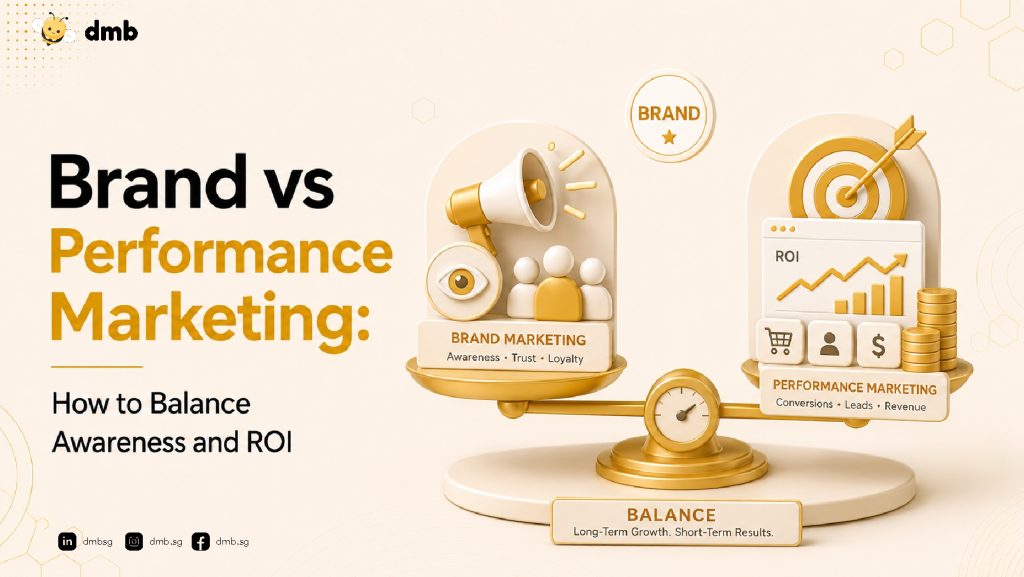
Many businesses face the same marketing dilemma: should they invest in brand marketing or performance marketing?
At first, performance marketing looks easier to justify. It gives visible numbers, clear dashboards, cost per lead, conversion rates, click-through rates, and return on ad spend. For business owners and marketing managers, this feels practical because every dollar appears measurable. You run Google Ads, people click, leads come in, and the campaign can be optimised based on results.
However, business growth is rarely that simple.
If people do not recognise your brand, trust your message, or understand why they should choose you, performance campaigns may become expensive over time. You may still get clicks, but the conversion rate may be weak. You may still get leads, but the lead quality may be inconsistent. You may still generate sales, but customers may switch easily when another competitor offers a lower price.
This is where brand marketing becomes important.
Brand marketing builds memory, trust, preference, and emotional connection. It helps people remember your business before they are ready to buy. Performance marketing captures demand when people are already searching, comparing, or ready to take action. In other words, brand marketing creates future demand, while performance marketing converts existing demand.
For businesses in a digital-first market, the question should not be “Brand vs performance marketing: which one is better?” The better question is: how can both work together to create short-term results and long-term growth?
According to DataReportal’s Digital 2025 Singapore report, Singapore had 5.61 million internet users at the start of 2025, with internet penetration reaching 95.8% of the population. This means customers are constantly exposed to brands, ads, content, reviews, search results, and comparison pages. In such a competitive environment, businesses need more than visibility. They need trust, relevance, and measurable performance.
That is why understanding the difference between brand and performance marketing is essential for companies that want to grow through digital marketing, Google Ads, SEO, content, and full-funnel strategy.
Brand vs Performance Marketing: What is the Difference?
Brand marketing and performance marketing are both important, but they serve different purposes.
Brand marketing focuses on building long-term awareness, recognition, trust, meaning, and preference. It answers the question: “Why should customers remember and choose this brand?”
Performance marketing focuses on measurable actions such as clicks, leads, purchases, bookings, sign-ups, or enquiries. It answers the question: “How can we get people to act now?”
The difference is not just about creative style. It is about time horizon, audience intent, measurement, message, and business objective.
Brand Marketing in Simple Terms
Brand marketing is the work of making your business known, remembered, and preferred. It helps customers understand what your brand stands for, what makes it different, and why they should trust it.
Brand marketing may include:
- Brand strategy
- Positioning
- Messaging
- Visual identity
- Storytelling
- Social media presence
- Thought leadership
- Video campaigns
- Public relations
- Community building
- Educational content
- Customer experience
- Reputation management
For example, a digital marketing agency may use brand marketing to communicate that it is strategic, transparent, data-driven, and focused on business growth. This message may appear across the website, articles, case studies, social media, videos, and client communication.
The goal is not always to generate an immediate enquiry. Instead, the goal is to build familiarity and trust, so that when customers need a service later, the brand is already in their mind.
Performance Marketing in Simple Terms
Performance marketing is focused on actions that can be tracked and measured. It is often used to generate leads, sales, app installs, calls, bookings, form submissions, or ecommerce purchases.
Performance marketing may include:
- Google Search Ads
- Performance Max campaigns
- Meta Ads
- LinkedIn Ads
- YouTube action campaigns
- Retargeting campaigns
- Shopping Ads
- Landing page optimisation
- Conversion rate optimisation
- A/B testing
- Lead generation campaigns
- Affiliate marketing
For example, a business may run Google Search Ads for keywords such as “Google Ads agency,” “digital marketing agency,” or “lead generation services.” The goal is to appear when potential customers are already searching for solutions.
Performance marketing is powerful because it can capture intent. However, if the brand is unknown or the landing page does not build confidence, the campaign may still struggle to convert.
Why Businesses Often Over-Focus on Performance Marketing
Performance marketing is attractive because it produces fast signals. You can see impressions, clicks, cost per click, conversions, cost per acquisition, and return on ad spend. This makes it easier to explain to management or clients.
Harvard Business Review has noted that performance marketing became compelling because it allows companies to run highly targeted campaigns and measure ROI more clearly. This solves a long-standing problem in advertising: understanding which marketing spend actually works.
However, the strength of performance marketing can also become a weakness. Because it is measurable in the short term, businesses may over-invest in bottom-funnel campaigns and under-invest in brand building.
Nielsen’s 2024 marketing insight highlighted that many marketers planned to increase performance marketing spend at the expense of brand building, even though the famous Binet and Field 60:40 rule suggests that, over time, many brands benefit from balancing approximately 60% brand-building investment and 40% sales activation. The exact ratio can vary by category, maturity, budget, market condition, and business goal, but the principle remains useful: short-term conversion activity needs long-term brand strength behind it.
The Risk of Only Chasing Immediate Conversions
If a business only runs performance campaigns, it may face several problems:
- Rising cost per click
- Lower conversion rates
- Weak brand recall
- Heavy dependence on paid traffic
- Price-sensitive customers
- Poor differentiation
- Limited organic demand
- Lower trust from cold audiences
- Difficulty scaling campaigns profitably
At first, performance marketing may work well because there is existing demand. However, after capturing the easiest opportunities, growth may slow down. The business then needs more budget to reach the same results.
This happens because performance marketing is often better at harvesting demand than creating demand. If not enough people know, trust, or prefer the brand, there may not be enough demand to capture.
Why Brand Marketing Still Matters in a Performance-Driven World
Brand marketing matters because most customers are not ready to buy immediately. They may be researching, comparing, waiting for budget approval, discussing internally, or simply becoming aware of a problem.
If your business only appears when people are ready to buy, you may enter the customer journey too late. By that point, they may already trust another brand.
Think with Google explains that in many categories, only a small percentage of customers are ready to buy at any given time. Therefore, brands need to build awareness and positive associations before customers enter the market.
Brand marketing helps businesses become familiar before the sales moment. That familiarity can improve performance later because people are more likely to click, trust, and convert when they recognise the brand.
Brand Marketing Builds Mental Availability
Mental availability means people are more likely to think of your brand in buying situations. For example, when a business owner thinks, “We need help with Google Ads,” which agency comes to mind first?
That is the result of brand building.
Mental availability is created through repeated, consistent, and distinctive brand signals. These signals may include your name, visual identity, tagline, tone of voice, content topics, customer stories, and category positioning.
Brand Marketing Reduces Perceived Risk
Customers often feel at risk before buying. They may wonder:
- Will this company deliver what it promises?
- Is this service worth the cost?
- Can I trust the team?
- What if the campaign fails?
- What if I choose the wrong provider?
Brand marketing reduces these doubts by building credibility before the conversion moment. A strong brand feels safer to choose.
Brand Marketing Supports Pricing Power
When a brand is trusted and differentiated, it does not always need to compete only on price. Customers may be willing to pay more because they believe the brand offers better value, lower risk, or a stronger experience.
This is especially important for service-based businesses. If two agencies offer Google Ads management, the customer may choose the one that appears more credible, strategic, and transparent — even if it is not the cheapest.
Why Performance Marketing Still Matters
While brand marketing is essential, performance marketing is also necessary. A strong brand without a clear conversion system can still fail to generate revenue.
Performance marketing helps businesses turn attention into action. It connects demand to measurable outcomes.
For example, a potential customer may already know your brand, but they still need a clear next step. Google Search Ads, landing pages, remarketing, and lead forms can help move that person from awareness to enquiry.
Google Ads explains that Performance Max is a goal-based campaign type that allows advertisers to access Google Ads inventory from a single campaign. It is designed to complement keyword-based Search campaigns and help advertisers find more converting customers across channels such as Search, YouTube, Display, Discover, Gmail, and Maps.
This shows how modern performance marketing is becoming more integrated. It is no longer only about simple search ads. It can combine automation, audience signals, creative assets, conversion goals, and cross-channel reach.
Performance Marketing Gives Fast Feedback
Performance campaigns help businesses learn quickly. You can test:
- Which keywords drive leads
- Which ad headlines get clicks
- Which landing pages convert better
- Which offers generate enquiries
- Which audience segments perform best
- Which locations produce higher-quality leads
- Which devices or times perform better
This feedback can improve not only ad performance but also brand messaging. For example, if certain pain points convert better in Google Ads, those insights can inform website copy, content strategy, sales scripts, and brand positioning.
Performance Marketing Helps Capture High-Intent Demand
Search advertising is especially powerful because it reaches people who are actively looking for something. A user searching for “Google Ads agency” is showing stronger intent than someone passively scrolling social media.
Therefore, performance marketing is useful when:
- The offer is clear
- The audience has existing demand
- The landing page is strong
- The conversion path is simple
- The business can track leads properly
- The sales team can follow up quickly
Performance marketing works best when it is connected to a strong brand, not separated from it.
Brand Marketing vs Performance Marketing: Key Comparison
Here is a practical comparison for business owners and marketing teams.
Main Objective
Brand marketing builds awareness, trust, preference, and long-term demand. Performance marketing drives measurable actions such as leads, purchases, bookings, and enquiries.
Time Horizon
Brand marketing usually works over a longer period. Performance marketing can produce faster signals and short-term results.
Audience Intent
Brand marketing often reaches people before they are ready to buy. Performance marketing often targets people who are already searching, comparing, or closer to conversion.
Metrics
Brand marketing is measured through awareness, reach, share of search, branded search volume, engagement quality, sentiment, direct traffic, brand recall, and long-term sales impact.
Performance marketing is measured through clicks, conversions, CPA, ROAS, conversion rate, lead quality, revenue, and cost per lead.
Creative Style
Brand marketing often uses storytelling, emotion, differentiation, and consistent identity. Performance marketing often uses direct response messaging, offers, benefits, proof, and clear calls to action.
Business Role
Brand marketing makes future sales easier. Performance marketing turns current demand into measurable results.
The Best Strategy: Brand and Performance Working Together
The strongest marketing strategy does not treat brand and performance as enemies. It connects both.
McKinsey describes full-funnel marketing as an approach that combines brand building and performance marketing through linked teams, measurement systems, and KPIs. McKinsey also notes that a thoughtful, data-driven full-funnel strategy can increase marketing ROI by 15% to 20% by shifting media allocation to higher-return areas and using test-and-learn optimization.
This is important because customers do not move through a perfectly linear funnel. They may see a YouTube video, read an article, search on Google, compare agencies, visit a website, leave, return later through remarketing, and finally submit a form after reading a case study.
A full-funnel strategy recognises that every touchpoint has a role.
How Brand Supports Performance
Brand marketing improves performance marketing by making people more familiar with the business. This can lead to:
- Higher click-through rates
- Better landing page trust
- Stronger conversion rates
- More branded searches
- Higher-quality leads
- Lower resistance in sales conversations
- Better remarketing response
For example, a user who has already seen your educational content may be more likely to click your Google Search Ad later. They are not seeing you for the first time. The brand already feels somewhat familiar.
How Performance Supports Brand
Performance marketing also supports brand marketing by providing data. It shows what people search for, what messages they respond to, what pain points matter, and what offers generate action.
This helps brand teams avoid vague assumptions. Instead of guessing what the market cares about, they can use performance insights to sharpen positioning, content, and messaging.
A Practical Full-Funnel Framework for Google Ads
For businesses that need Google Ads leads, brand and performance can be connected through a structured full-funnel approach.
Awareness Stage
At the awareness stage, people may not be ready to buy. They may not even know the exact solution they need. The goal is to educate, introduce the brand, and build relevance.
Recommended Channels
- YouTube Ads
- Demand Gen campaigns
- SEO articles
- LinkedIn content
- Educational videos
- Social media content
Consideration Stage
At the consideration stage, users are comparing solutions. They may be reading guides, checking service pages, reviewing portfolios, or comparing agencies.
Recommended Channels
- Google Search Ads
- SEO comparison articles
- Case studies
- Remarketing
- Email nurturing
- Landing pages
Conversion Stage
At the conversion stage, users are ready to take action. The goal is to reduce friction and make the next step clear.
Recommended Channels
- High-intent Search Ads
- Performance Max
- Retargeting
- Dedicated landing pages
- Lead form extensions
- Consultation CTAs
Retention Stage
After conversion, marketing should not stop. Existing customers can become repeat buyers, long-term clients, and referral sources.
Recommended Channels
- Email marketing
- Customer Match
- Remarketing
- Loyalty content
- Reporting dashboards
- Client education
How to Measure Brand and Performance Together
One of the biggest challenges is measurement. Brand and performance are often measured separately, which creates internal conflict.
Performance teams may say, “Brand campaigns do not convert.” Brand teams may say, “Performance campaigns damage long-term positioning.” Both can be partly right if the measurement system is too narrow.
A better approach is to use blended measurement.
Brand Metrics to Track
- Brand awareness
- Brand recall
- Share of search
- Branded search volume
- Direct website traffic
- Organic traffic growth
- Social engagement quality
- Review volume and sentiment
- Returning visitors
- Content engagement
Performance Metrics to Track
- Click-through rate
- Conversion rate
- Cost per lead
- Cost per acquisition
- Return on ad spend
- Sales qualified leads
- Lead-to-customer rate
- Average order value
- Customer lifetime value
- Revenue from paid channels
Combined Metrics to Track
- Assisted conversions
- Branded search after awareness campaigns
- Conversion rate by audience familiarity
- New vs returning visitor conversion rate
- Lead quality by campaign source
- Customer acquisition cost vs lifetime value
- Incremental revenue from full-funnel campaigns
The goal is not to force brand campaigns to behave like bottom-funnel ads. Instead, measure each activity based on its role in the customer journey.
Common Mistakes Businesses Should Avoid
1. Expecting Brand Campaigns to Convert Immediately
Brand campaigns can influence future sales, but they are not always designed to produce instant enquiries. Measuring them only by last-click conversions can undervalue their impact.
2. Running Performance Campaigns Without Brand Trust
If your landing page has weak messaging, no proof, poor design, or unclear positioning, even high-intent traffic may not convert well.
3. Using the Same Creative for Every Funnel Stage
A first-time audience needs education and relevance. A high-intent searcher needs clarity and proof. An existing customer needs retention messaging. One ad cannot do everything well.
Think with Google warns that “double-duty” ads that try to serve both brand-building and performance objectives in one creative execution can underperform. Brand and performance should work together, but each campaign should still have a clear role.
4. Separating Brand and Performance Teams
When brand and performance teams work in silos, messaging becomes inconsistent. The brand team may create emotional campaigns while the performance team writes direct-response ads that sound completely different.
A better approach is shared planning. Brand strategy should inform performance campaigns, and performance data should inform brand strategy.
5. Optimising for Leads Instead of Business Quality
Not all leads are equal. A low cost per lead may look good, but if the leads do not convert into revenue, the campaign is not truly performing.
Businesses should track lead quality, sales conversion rate, and customer lifetime value, not only form submissions.
Why Trust Matters in Both Brand and Performance Marketing
E-E-A-T stands for Experience, Expertise, Authoritativeness, and Trustworthiness. Google Search Central explains that content should be helpful, reliable, and people-first, and recommends evaluating content through “Who, How, and Why.”
For a business website, this matters because brand trust and search visibility are connected. A company that publishes shallow, generic content may struggle to build authority. A company that shares practical insights, transparent case studies, expert commentary, and clear service information is more likely to build trust with both users and search engines.
To strengthen E-E-A-T in a brand vs performance marketing article or service page, businesses should include:
- Real examples from campaign experience
- Clear definitions and practical frameworks
- Author or company expertise
- References to credible industry research
- Case studies and client outcomes
- Transparent methodology
- Clear service process
- Honest explanation of limitations
- Helpful next steps for readers
This is especially important for businesses offering Google Ads services. Potential clients want to know that the team understands not only bidding and keywords, but also positioning, landing pages, conversion tracking, customer intent, and long-term growth.
When Should a Business Prioritise Brand Marketing?
A business may need more brand marketing when:
- People do not recognise the company
- Competitors look very similar
- The business relies heavily on discounts
- Conversion rates are low despite traffic
- Customers do not understand the value proposition
- The sales team hears “I have never heard of you”
- Branded search volume is weak
- The business wants to enter a new category
- The product or service requires trust before purchase
Brand marketing is especially important for new businesses, premium services, complex solutions, and competitive categories.
When Should a Business Prioritise Performance Marketing?
A business may need more performance marketing when:
- There is clear search demand
- The offer is already validated
- The website or landing page is ready
- The business needs leads or sales now
- Tracking and analytics are properly set up
- The sales team can follow up quickly
- The brand already has some trust or market presence
- The business wants to test offers, messages, or segments
Performance marketing is especially useful when the business has clear conversion goals and a strong enough customer journey to support paid traffic.
So, Which One is Better?
Brand marketing and performance marketing are not competing choices. They are different parts of the same growth system.
Brand marketing makes people remember, trust, and prefer your business. Performance marketing helps convert that attention into measurable action.
If you only invest in brand marketing, you may build awareness without enough sales. If you only invest in performance marketing, you may generate short-term leads while weakening long-term demand.
The best approach is balance.
For some businesses, that balance may mean starting with performance marketing to generate cash flow while gradually building brand assets. For others, it may mean investing more in brand strategy first because the market does not yet understand the offer. The right answer depends on business maturity, budget, competition, customer journey, and growth goals.
However, one principle remains clear: performance works better when brand trust exists, and brand becomes more valuable when performance systems can capture demand.
Conclusion
The debate around brand vs performance marketing often creates a false choice. Businesses do not need to choose one and abandon the other. They need to understand the role of each.
Brand marketing builds long-term memory, trust, differentiation, and preference. Performance marketing drives measurable actions such as clicks, leads, sales, and enquiries. One creates demand. The other captures demand. One makes the business easier to remember. The other makes it easier to convert.
For businesses using Google Ads, this balance is especially important. Search Ads, Performance Max, remarketing, and landing pages can produce strong results, but they work best when supported by clear positioning, credible proof, useful content, and a trustworthy brand experience.
In a competitive digital market, the businesses that grow sustainably are not always the ones that spend the most. They are the ones that connect brand and performance into one clear system. They build trust before the click, capture intent during the search, and continue creating value after the conversion.
That is how marketing becomes more than traffic. It becomes a long-term growth engine.
Free Expert
Digital Marketing Consultation
Our expert digital marketing consultants offer you a no-risk marketing consultation that covers
Developing a tailored strategy to boost your leads and sales.
Uncovering the five key elements vital for digital marketing success.
See what your competitors are up to and learn how to beat them.