


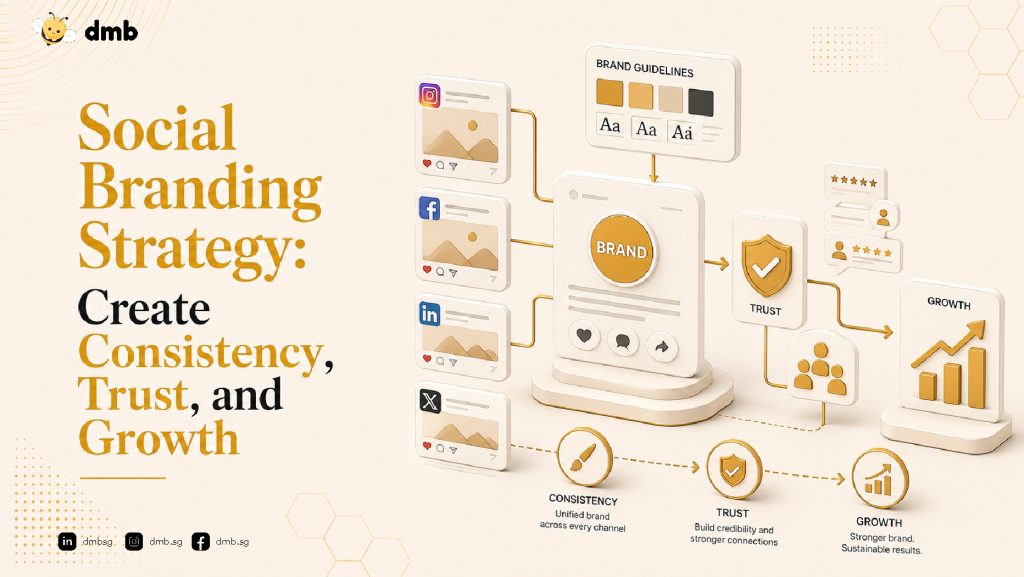
A brand is no longer shaped only by its logo, website, packaging, or advertising campaign. Today, people often form their first impression through a social media post, a short video, a comment reply, or a customer story.
That is why social media branding matters.
When someone visits a company’s Instagram, LinkedIn, TikTok, YouTube, or Facebook page, they are not only looking at content. They are quietly deciding whether the brand feels relevant, credible, useful, and worth remembering.
For businesses, this creates both an opportunity and a challenge. Social media makes it easier to reach audiences at scale. However, it also creates a crowded environment where many brands publish similar content, use similar visuals, and follow the same trends.
A strong brand presence helps a business avoid becoming interchangeable.
It gives audiences a reason to recognise the company, trust its expertise, and return when they are ready to make a decision. More importantly, it ensures that every social interaction contributes to a bigger perception of what the business stands for.
This guide explains how businesses can build meaningful social media branding that goes beyond posting frequently and starts creating long-term brand value.
What Is Social Media Branding and Why Does It Matter?
Social media branding is the process of expressing a brand’s identity, values, personality, expertise, and positioning consistently across social platforms.
It is not limited to visual design. While colours, typography, layouts, and logos are important, branding also includes how a company communicates, responds, teaches, tells stories, and builds relationships with its audience.
In simple terms, social media branding answers important questions such as:
- What should people associate with this business?
- What makes this brand different from competitors?
- How should the brand sound in public conversations?
- What type of value does the brand consistently provide?
- Why should people trust the business?
- What feeling should the audience have after seeing the content?
For example, a technology company may want to be known for making complex digital solutions easier to understand. A financial business may want to build a reputation for clarity, transparency, and responsible education. Meanwhile, a creative agency may want to be recognised for bold ideas, practical insights, and measurable growth.
The key is consistency.
If a brand looks premium in one post but sounds overly casual in the next, audiences may struggle to understand what it represents. Likewise, if content appears informative one week and purely promotional the next, trust can weaken over time.
Therefore, branding should not be treated as a separate layer added after content creation. It should guide the content from the beginning.
Build a Clear Digital Brand Identity Before Posting
Many brands begin their social media activity by asking, “What should we post this week?”
A better question is, “What should people remember about us after seeing our content repeatedly?”
Before building a content calendar, establish a clear digital brand identity.
Define Your Brand Promise
A brand promise is the value people can expect from your business.
It should not be a generic statement such as “we provide the best service.” Instead, it should communicate a specific and believable benefit.
For instance:
- We make financial knowledge easier to understand.
- We help businesses turn digital activity into measurable growth.
- We simplify technology decisions for growing teams.
- We help ambitious brands communicate with more clarity.
- We create practical strategies, not only creative campaigns.
A strong brand promise gives your content direction. It helps the team decide whether a post fits the brand or simply fills space.
Clarify Your Brand Personality
Brand personality describes how your business behaves and communicates.
A brand may be:
- Insightful and analytical
- Warm and approachable
- Bold and challenging
- Premium and refined
- Practical and straightforward
- Energetic and optimistic
- Calm and reassuring
The goal is not to choose every personality trait. Instead, choose two to four traits that feel natural to the business and relevant to the audience.
For example, a finance-focused brand may combine “clear, responsible, and confident.” A digital marketing company may use “curious, practical, and growth-focused.”
Once this personality is defined, it becomes easier to maintain a recognisable voice across captions, videos, direct messages, campaign pages, and customer replies.
Create a Brand Voice That Sounds Human
A brand voice is the consistent way a company communicates.
It is not about sounding overly formal or trying too hard to sound trendy. Instead, it is about making sure the brand communicates in a way that feels recognisable and trustworthy.
A practical brand voice guide should include:
| Brand Voice Element | Example Guidance |
| Tone | Clear, warm, and confident |
| Vocabulary | Use simple language; avoid unnecessary jargon |
| Sentence Style | Short paragraphs with direct explanations |
| Opinion | Offer useful perspectives, not empty statements |
| Customer Interaction | Helpful, respectful, and responsive |
| Sales Language | Consultative rather than pushy |
For instance, instead of writing:
“We are the leading provider of innovative solutions.”
A more useful and credible version may be:
“We help businesses identify where their digital journey is losing momentum, then build practical systems to improve it.”
The second message sounds more specific. It also helps the audience understand the actual value of the business.
In social media branding, specificity builds stronger recognition than broad claims.
Make Visual Consistency Work Across Platforms
Visual consistency does not mean every post should look identical. In fact, overly repetitive content can feel predictable and limit audience engagement.
Instead, visual consistency means that the brand remains recognisable even when formats change.
A social media visual system may include:
- Primary and secondary brand colours
- A consistent typeface selection
- Repeating layout structures
- Image direction or photography style
- Illustration or icon style
- Video cover design
- Presentation templates
- Branded graphic elements
- Consistent use of spacing and hierarchy
For example, an educational carousel may use one format, while a customer testimonial uses another. However, both should still feel connected through colour, typography, tone, and visual balance.
This approach helps content stand out in crowded feeds without forcing audiences to read the account name every time.
Keep Platform Context in Mind
Brand consistency should not become rigid repetition.
Each platform has different audience expectations and content behaviour. LinkedIn may reward thought leadership and professional expertise. Instagram may be more suited to visual storytelling, behind-the-scenes content, and brand personality. TikTok may work well for fast, relatable explanations and short-form educational videos.
The brand should remain recognisable, but the format should adapt to the platform.
In other words, the message stays consistent while the delivery changes.
Build Content Pillars That Strengthen Brand Recall
A strong social media brand is built through repeated associations.
When audiences repeatedly see a company explain the same type of problem, share the same kind of expertise, and communicate through a consistent perspective, they begin to associate that brand with a particular value.
This is where content pillars become useful.
Content pillars are recurring themes that help a business publish consistently without becoming repetitive.
A Practical Content Pillar Framework
1. Educational Insight
Educational content helps the audience understand a topic, solve a problem, or make better decisions.
Examples include:
- How-to posts
- Step-by-step guides
- Industry myths versus facts
- Simple explanations of complex topics
- Frameworks and checklists
- Trend analysis
- Common mistakes to avoid
Educational content is especially valuable for businesses in technology, marketing, finance, consulting, and professional services because it demonstrates expertise before a prospect begins a formal buying process.
2. Brand Perspective
A strong brand should have a point of view.
This does not mean posting controversial opinions simply to create engagement. Instead, it means sharing informed perspectives that help audiences see a problem differently.
For example:
- Why more traffic does not always mean more growth
- Why brand trust should be measured beyond follower count
- Why automation should improve customer experience, not replace it
- Why financial education should be simple and transparent
- Why businesses should prioritise clarity before scaling content
These perspectives help a brand move beyond generic content and become more memorable.
3. Proof and Credibility
People are more likely to trust what they can verify.
Proof-based content may include:
- Customer testimonials
- Case studies
- Project outcomes
- Team expertise
- Awards or certifications
- Media mentions
- Customer reviews
- Behind-the-scenes processes
- Before-and-after examples
This type of content is essential because social media branding is not only about what a company says about itself. It is also about what others can see, experience, and validate.
4. Human Stories
Businesses are ultimately made of people.
Founder stories, employee perspectives, daily routines, team achievements, challenges, and behind-the-scenes moments can make a brand more approachable.
Human content is particularly useful for service businesses because customers often want to understand the people behind the offer before they make contact.
However, human content should still connect to the brand. A random office photo may receive a few likes, but a story about how the team solves a customer problem can create deeper relevance.
5. Community and Conversation
Strong brands do not only publish. They participate.
Community content may include:
- Responding to audience questions
- Featuring customer stories
- Inviting opinions
- Hosting live discussions
- Sharing user-generated content
- Asking followers about real business challenges
- Turning recurring questions into educational posts
This makes the brand feel present rather than distant.
Trust Signals: The Foundation of Long-Term Brand Equity
Social media gives businesses visibility, but visibility alone does not create trust.
Trust is built when a brand repeatedly shows competence, transparency, consistency, and care.
For this reason, businesses should actively include trust signals in their content ecosystem.
Useful trust signals include:
- Clear explanations instead of vague claims
- Customer reviews and testimonials
- Visible expertise from founders or specialists
- Honest discussion of limitations or risks
- Consistent response to comments and messages
- Transparent partnership disclosures
- Reliable information supported by credible sources
- Real examples of process and delivery
- Updated company information across profiles
Trust also becomes more important in an environment where audiences are exposed to automated content, misinformation, and low-quality engagement bait.
Therefore, businesses should be careful not to overuse generic AI-style captions, artificial testimonials, or exaggerated promises. A polished social account may attract attention, but audiences increasingly look for signs that there are real people, real expertise, and real accountability behind the brand.
Use AI Without Losing Brand Authenticity
AI can help marketing teams improve speed, research, content repurposing, idea generation, and production efficiency.
However, AI should support brand expression, not replace it.
When every caption, video script, or visual follows the same automated pattern, the brand can become less distinctive. The audience may see more content, but remember less of it.
A better approach is to use AI for operational support while keeping human judgment at the centre.
For example, AI can help teams:
- Organise content ideas
- Summarise customer feedback
- Draft initial outlines
- Repurpose long-form content
- Analyse recurring comment themes
- Create first versions of social captions
- Improve workflow efficiency
At the same time, people should still review the final message, verify facts, add lived experience, and ensure the tone reflects the brand.
The strongest brands use technology to become more useful and responsive, not more generic.
Measure Brand Strength Beyond Vanity Metrics
Likes and follower numbers can be useful indicators, but they are not enough to show whether branding is working.
A business should also measure whether audiences are beginning to recognise, trust, and act on the brand.
Useful indicators include:
| Brand Objective | Metrics to Track |
| Visibility | Reach, impressions, profile visits, video views |
| Recognition | Branded search growth, direct traffic, repeat viewers |
| Engagement Quality | Saves, shares, meaningful comments, direct messages |
| Trust | Testimonials, positive mentions, customer questions, review sentiment |
| Consideration | Website visits, content downloads, service-page traffic |
| Conversion | Consultation bookings, enquiries, qualified leads, sales opportunities |
In addition, teams should review qualitative signals.
Are people asking more informed questions? Are prospects mentioning specific posts during sales calls? Are customers sharing content voluntarily? Are direct messages becoming more relevant to the business offer?
These signals often reveal brand momentum before it appears clearly in a dashboard.
Strengthen E-E-A-T Through Your Social Presence
A credible social media brand should demonstrate Experience, Expertise, Authoritativeness, and Trustworthiness.
Show Experience
Share practical lessons from real work, projects, customer challenges, and campaign decisions. Explain what worked, what changed, and what was learned.
Demonstrate Expertise
Use subject-matter experts, founders, specialists, and practitioners to explain topics clearly. Avoid publishing vague advice that could apply to every business.
Build Authoritativeness
Support claims with recognised research, credible industry sources, customer proof, and original insights. Create content that is helpful enough for people to save, share, and return to.
Protect Trustworthiness
Be transparent about partnerships, sponsored content, data sources, and limitations. Correct errors when they happen, respond professionally, and avoid making claims that cannot be supported.
E-E-A-T is not a design style. It is the cumulative result of how a brand behaves over time.
A Simple 30-Day Social Media Branding Plan
For businesses that want to improve their brand presence without overcomplicating the process, start with a focused 30-day plan.
Week 1: Clarify the Brand Foundation
- Define the brand promise
- Identify three brand personality traits
- Create a basic voice guide
- Review social profile bios, links, and profile images
- Identify customer questions and objections
Week 2: Build the Content System
- Create four to five content pillars
- Prepare reusable visual templates
- Draft one month of content ideas
- Set a realistic posting schedule
- Plan one trust-building content piece each week
Week 3: Publish and Engage
- Publish consistently
- Respond to comments and messages
- Track the questions people ask
- Review which formats generate saves and shares
- Repurpose one strong post into another format
Week 4: Review and Improve
- Analyse reach, engagement, and profile visits
- Identify the highest-performing content topics
- Review audience feedback
- Update weak calls to action
- Plan the next month based on actual results
This process creates momentum without forcing the team to chase every trend or publish content without purpose.
Conclusion
Social media branding is not about making every post look perfect. It is about making every interaction feel connected to the same brand promise.
A strong social presence helps people recognise what the business stands for, understand its expertise, and feel more confident about engaging with it.
The most effective brands do not rely on random content or constant promotion. Instead, they use social media to educate, build trust, show proof, participate in conversations, and create a distinct point of view.
Over time, this consistency becomes an advantage.
When audiences see a familiar visual identity, hear a recognisable voice, and repeatedly receive useful value, the brand becomes easier to remember and easier to choose.
Free Expert
Digital Marketing Consultation
Our expert digital marketing consultants offer you a no-risk marketing consultation that covers
Developing a tailored strategy to boost your leads and sales.
Uncovering the five key elements vital for digital marketing success.
See what your competitors are up to and learn how to beat them.